According to CCTV news, on July 31st, local time, the Bank of Japan held a monetary policy meeting.Decided to adjust the current policy interest rate from 0% to 0.1% to 0.25%.This rate hike is the first since the negative interest rate policy was lifted in March this year. In addition, the Bank of Japan also decided to reduce the purchase scale of Japanese government bonds in the next one to two years.
On March 19th this year, the Bank of Japan decided to end the negative interest rate policy and raise the policy interest rate from -0.1% to 0-0.1%, which was the first time for the Bank of Japan to raise interest rates in 17 years since February 2007.
The Bank of Japan introduced ultra-loose monetary policy in 2013. In February 2016, the Bank of Japan began to implement a negative interest rate policy, reducing the interest rate of commercial banks’ excess reserve deposits from the previous 0.1% to -0.1%. The Bank of Japan is the first central bank in the world to implement a negative interest rate policy. The Bank of Japan tried to stimulate economic growth and raise inflation through this unconventional monetary policy.
As of the close of July 31, the Nikkei 225 index closed up 1.49% at 39,101.82 points. The yield of Japanese five-year government bonds rose by 7.5 basis points to 0.660%, the highest level since November 2009.
According to shanghai securities news, analysts believe that the Bank of Japan cut its bond purchases while raising interest rates, demonstrating its determination to normalize its policies. The Bank of Japan also hinted in its statement that it may continue to tighten monetary policy in the future. "The future monetary policy operation will depend on the future development of economic activities, prices and financial conditions. However, given that the real interest rate is at a significantly low level, if the prospects put forward in the outlook report in July can be realized, the central bank will continue to raise the policy interest rate accordingly and adjust the degree of monetary easing."
On July 31, Bank of Japan Governor Kazuo Ueda said that it is appropriate to adjust the easing policy from the perspective of achieving the sustainability and stability of 2% inflation. The real interest rate may still be significantly negative, and the relaxed financial environment will continue to support the economy. If the current economic and price prospects are realized, we will continue to raise interest rates and adjust the intensity of easing policies.Whether to continue to raise interest rates during the year will depend on data performance.
According to china securities journal, the Bank of Japan’s interest rate hike is somewhat hasty. The reason is that raising interest rates may delay the recovery of domestic demand and put pressure on economic growth, while the slowdown of the US economy and the appreciation of the yen may also drag down economic growth.
Stefan Angrick, a senior economist at Moody’s Analytics, said that the Bank of Japan’s interest rate hike is likely to be considered as one of the most controversial interest rate hikes, because even typical hawks in Japan agree that the Bank of Japan should keep interest rates unchanged in view of the poor economic situation. At best, a small interest rate hike will further drag down economic growth, and at worst, it may trigger a broader economic downturn.
Naomi Muguruma, strategist at Mitsubishi UFJ Morgan Stanley Securities, said that the Bank of Japan’s statement shows that its position has become tougher. She said that unless the economy falls sharply, the Bank of Japan may raise interest rates again later this year.
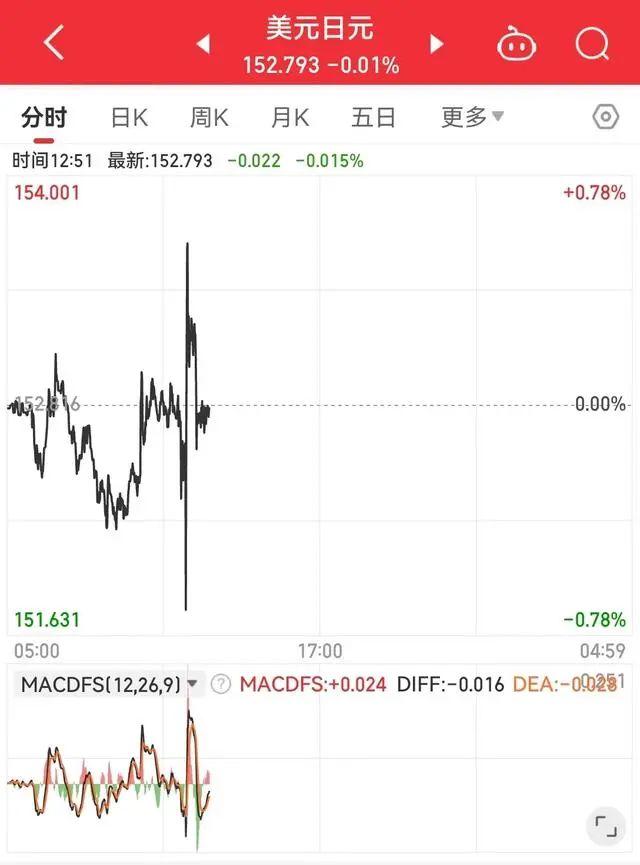
Affected by the Bank of Japan’s unexpected interest rate hike, USD/JPY fell by 110 points in the short term, and the lowest fell to 151.58, which is exactly the strong support of the 200-day moving average; Subsequently, the exchange rate rebounded rapidly, hitting a maximum of 153.88.
The yen has been depreciating since this year. On July 12, shortly after the release of the consumer price index (CPI) data in the United States, the exchange rate of the Japanese yen against the US dollar rebounded strongly, once soaring to 157.44 yen against the US dollar, the largest one-day increase since the end of 2022, with an increase of nearly 3%.
Japanese media reported on July 16th that according to the data on the increase and decrease of funds released by the Bank of Japan, market stakeholders analyzed and calculated that on July 12th, the Japanese government and the Bank of Japan may have intervened in the foreign exchange market by buying yen and selling dollars, and the scale of funds used is estimated to be around 2 trillion yen (about 91.7 billion yuan). However, the Japanese government did not announce whether it had intervened.
According to CCTV news, according to the report released by the Bank of Japan on May 29th, the valuation loss (floating loss) of the national debt held by it in the fiscal year of 2023-2024 (from April 2023 to March 2024) reached 9,433.7 billion yen, a record high in the same period in history.
The Bank of Japan announces the final accounts of the past fiscal year in May every year.
According to the fiscal year final accounts released this time, as of the end of March 2024, the balance of national debt held by the Bank of Japan increased by 1.4% year-on-year, reaching 58,966.34 billion yen, a record high for two consecutive years. If the long-term interest rate rises further, the valuation loss may continue to increase.
edit|Dubo, Sun Zhicheng
proofread|Lu xiangyong
The cover picture is taken by every special correspondent Hao Shuai.

National business daily is integrated from CCTV News, china securities journal, shanghai securities news, etc.
national business daily