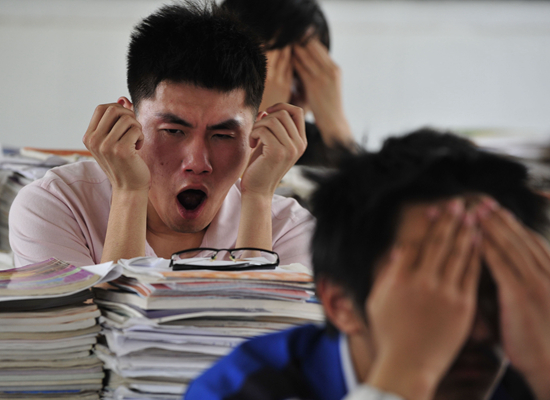
Senior three students. Photo courtesy of vision china
Self-study at 7 am, self-study at 10 pm, and study for more than 12 hours a day. Almost all senior three students in all parts of the country have entered the state of preparing for the college entrance examination, while some senior two students have entered the last six months of course study.
10.31 million is the number of applicants for the national college entrance examination in 2019. Under the pressure of many parties, the promotion function of high school education has given way to the selection function, and it has long been a normal state that the second year of high school completes the teaching task of high school and the third year of high school becomes the stage of reviewing for the exam.
China’s modern educational system began with the "Renyin" educational system. In 1922, the "Renxu" school system, or "633" school system, was implemented until the founding of New China. After several changes, by the mid-1980s, the "six-three-three" academic system had been restored in most parts of China. Since then, the academic system of senior high school has been basically stable for three years. According to media reports, some schools in Sichuan and Hebei have explored the implementation of the "two-four academic system", that is, two years in junior high school and four years in senior high school.
So how many years in high school? Now it has become a problem. Lao Kaisheng, the chief professor of education in Capital Normal University, believes that "the problem of high school education is not how many years to study, but the key is to arrange and implement the curriculum and teaching content reasonably according to the academic system."
Every day is the same in the last year of high school.
After the summer vacation, Zhao Long, who graduated from Anhui Jieshou No.1 Middle School, became a freshman majoring in computer science in Anhui Normal University. He described himself as if he had been in high school for two years, because he was reviewing in the last year of high school.
"Get up at 5: 40, study in the morning at 6: 40, have classes at 8: 00, have four classes in the morning and afternoon, and study in the evening at 10: 00. You can only rest on Sunday morning every two weeks. " This is Zhao Long’s senior three timetable, and it is also the schedule of many senior three students. Hu Min, a senior three student at Laibin No.1 Middle School in Guangxi, feels: "Every day is the same."
Zhao Long still remembers the frequent exams in senior three. There are quizzes every day and placement exams once a week. Doing exercises and exams day after day bored Zhao Long with writing. During the interview, he would pause and say, "It’s like a composition question."
He thought of a way to avoid writing a composition. In the Chinese classroom exam, the teacher will ask the group leader to collect all the papers and hand them in to the office. After correcting them, the group leader will count the scores. Zhao Long is the team leader. He took advantage of his position to take out the papers that he didn’t write, and then registered a score for himself casually.
In fact, Zhao Long’s senior three started from the summer vacation of senior two. In his memory, the summer vacation was nothing more than the teacher in the class changing places and then going to class. "It is voluntary, but it is actually forced." "Ordinary Senior High School Curriculum Plan (Experiment)" stipulates that there are 11 weeks of holidays each academic year, but in fact, the summer vacation is only two weeks.
Liu Yu, who was admitted to Renmin University of China with high scores, never thought about her high school life and would have an experience of being a deserter.
Liu Yu got top marks in the No.1 Senior Middle School in Mengjin County, Henan Province. At the beginning of August 2018, the class teacher informed him and two other students in the class to take the selection exam in Hengshui. If the exam passed, the senior three could study in Hengzhong, and the college entrance examination would return to their hometown. The class teacher said that the school paid a great price and asked them to go back and discuss with their parents. "Parents are particularly supportive", Liu Yu said that everyone wants to go to Hengzhong, and I am no exception. "Being in Hengzhong is equivalent to stepping into Tsinghua Peking University".
At the end of August 2018, Liu Yu and 12 "top students" from the same school came to Hengzhong to take the exam. "There are a lot of people, and they are taking the exam with repeat students." He passed the selection exam, and before he could think clearly, he hurriedly signed up for payment under the "encouragement" of teachers and parents.
"No one spoke during recess." On the first day of Liu Yu’s arrival in the classroom, he was frightened. There were more than 100 students in a class, from the blackboard to the last row, all of them were crowded with people, and the depressed atmosphere wrapped around him. He remembered the pictures of classmates chatting and playing games with physical education class before recess. His heart ached and he decided to leave.
After Liu Yu returned to Henan, he found that the school also began to adopt the "Hengshui model", so he had no choice but to adapt. For a year and a half of review, he has his own views: the first time was rough, mainly because he was familiar with the teaching materials; The second docking college entrance examination, focusing on combing. "Quite reasonable, you can’t finish the direct college entrance examination."
"If the education reform, test scores only account for a small part, (school) teaching you practical ability, interpersonal skills, comprehensive ability, it is definitely a good resource that can’t catch up with big cities." Liu Yu said that all his classmates understand this truth and understand what the teacher said, "the college entrance examination changes fate."
From one-year preparation to two-year preparation
It seems that the "last year" of basic education has become a "review year", which has become a generally accepted reality. Behind the annual review of senior three is the teaching progress of catching up, grabbing and fighting in the first two years of senior high school. A three-year course is compressed into two years, or even a year and a half. On the way to teaching "speeding", some students were left behind and had to run with them all the way.
Wang Jia is a senior two student of Pingzhong Affiliated School in Pingxiang City, Jiangxi Province. She has been taking online classes in the past summer vacation. This is not the teacher’s request, but she took the initiative to register, in order to "catch up on the abandoned courses".
She reflected on the reasons for her poor grades, such as inattention and desertion, and some teachers rushed to catch up with the teaching progress and spoke too fast. "Just because a few students can keep up with the teacher doesn’t mean that the whole class can keep up."
Many students like Wang Jia report that their knowledge in senior one and senior two is not solid. "When reviewing in senior three, they feel that the textbook is just like a new one."
Zhao Tianyu, who graduated from the No.1 Middle School in Erdos City, Inner Mongolia, recalled that in high school, "I can’t learn and I can’t do well in the exam" is like two big stones on her body and heart. Every time the results come out, she holds the test paper and shouts, "Don’t learn, don’t learn". However, after crying, she still had to dry her tears, pick up the thrown books and continue to learn. She said: "Learning needs interest. In just three years, I have learned a lot in a bunch of subjects that I don’t like." She thinks that learning is the meaning of learning.
Zhang Ming feels that he is very similar to Fang Yifan in the popular TV series "Little Joy" in the previous paragraph: his grades are not good and he likes singing and dancing. He likes acting since he was a child. He has acted in two micro-movies and many drama sketches. Performance can satisfy many of Zhang Ming’s ideas. "I really enjoy the process of performance and another feeling of life under the camera."
Because he loves acting, Zhang Ming wants to take the art test, but he didn’t expect his parents and school to become a stumbling block on his dream. Shimen middle school, Nanhai District, Foshan, Guangdong, where he attended, is the best middle school in Nanhai District. "There is no music class in senior three". He once told his teacher, but the teacher told him that the school did not support the art test and could not provide any help and guidance. Zhang Ming’s father also voted against it. "It is unrealistic to study art and you can’t find a good job after graduation."
Zhang Ming, who loves freedom, feels bound by the framework of the college entrance examination. For nearly a year and a half of review, Zhang Ming commented: "Review is at best experience and promotion, and at worst it is a blank space that is persisted by will."
The school was caught in the middle.
Teachers hold a variety of views on the teaching methods to strengthen students’ ability to take exams, compress teaching time and lengthen review time, with some approval and some helplessness.
Hou Shengxin, an English teacher in the middle school affiliated to Henan University, thinks that there are advantages and disadvantages: "The exam-oriented teaching pays more attention to the ontology of knowledge and ignores the ability of students." She cited, for example, high school English, and now many places still learn dumb English; Another example is geography, which requires students to go out, understand the reality and integrate with life, rather than simply learning books.
"Compressing teaching time itself reduces the effective time for students to improve their practical application ability. In addition, it is even more unfavorable for students with weak foundations. " However, Mr. Hou also feels reasonable from another angle: "It is certainly not stupid for schools to compete to do this. Practice makes perfect and it is polished repeatedly."
In order to leave enough review time for one to one and a half years, teachers in all subjects have to attend two or three classes every day to catch up with the teaching progress; Schools should arrange self-study in the morning and evening, take classes on weekends, and extend the daily study time.
Teacher Chen is the head teacher of a high school in Baotou, Inner Mongolia. He said: "Under the exam-oriented education mode, schools pay attention to grades, and there is nothing they can do." Teacher Chen has to teach 12 class hours a week. This number of class hours, multiplied by the six subjects of the college entrance examination, has far exceeded the 35 class hours a week stipulated by the senior high school curriculum standards.
"Nothing can be done" is the word that Teacher Chen mentioned most in an interview. Local governments assess schools with the enrollment rate as the standard; The school assigns the indicators of one copy rate, heavy copy rate and Tsinghua Peking University to each class; Parents pin their children’s hopes of being admitted to a good university on teachers. Under heavy pressure, Mr. Chen said, "No way, teachers can only strengthen students’ ability to take exams through continuous review and examination."
Lao Kaisheng once studied the high school curriculum standards with a number of education experts. He said: "I think the high school curriculum is very tense after three years, and I am not the only one who thinks so." According to him, since 2016, some high-quality schools in Beijing have re-divided the middle school, with two years in junior high school and four years in senior high school.
This year, the Central Committee of the Communist Party of China and the State Council issued "Opinions on Deepening the Reform of Education and Teaching and Improving the Quality of Compulsory Education in an All-round Way", stating that it is strictly forbidden to exceed the standard of teaching, rush to catch up with the teaching progress and end the course ahead of schedule.
Teacher Chen said frankly that the local departments would report in advance before the review, "change the class schedule and remove the morning and evening self-study." Later, simply put a "compliance" schedule in the classroom, and the students performed another schedule. In fact, local departments turn a blind eye and even support in disguise. "Teachers’ night self-study fees are financial subsidies."
Parents of students also hold a favorable attitude. "It is efficient to study in school" and "you should study in senior three". With the help of parents and the acquiescence of local departments, the "review at the end of the year" has intensified.
Xiong Bingqi, vice president of the 21st Century Education Research Institute, thinks that the school is caught in the middle, the government should assess the enrollment rate of the school, and parents should emphasize what kind of university their children want to attend. Under the influence of these two forces, the school will take the way of speeding up, finish classes as soon as possible, and then carry out intensive review.
"Review at the end of the year" has become an unsolvable problem
In fact, the phenomenon of "review at the end of the year" is not unique to high schools, but also exists in junior high schools. Xiong Bingqi learned that junior high schools all over the country basically take two years to finish three years of classes, and the last year is used to brush the questions.
"The basic education of the 12-year academic system requires a complete education for students. In addition to knowledge learning, students must also receive life education, life education and survival education." Xiong Bingqi, for example, said that high school students in the United States and Canada got the university admission notice in December, but they had to complete the last semester.
The education department has explicitly prohibited training institutions from teaching ahead of time and teaching ahead of time, but the "review at the end of the year" that is common in junior and senior high schools is still regarded as normal, which Xiong Bingqi thinks is a very abnormal phenomenon.
Opinions on Deepening the Reform of Education and Teaching and Improving the Quality of Compulsory Education in an All-round Way puts forward the main task of improving the quality of compulsory education in an all-round way. The first task is to adhere to the "five educations" and develop quality education in an all-round way. Highlight the effectiveness of moral education, improve the level of intellectual education, strengthen physical exercise, enhance aesthetic education, strengthen labor education, and promote the all-round development of students.
Xiong Bingqi summed up this phenomenon as two factors. First, the local government does not administer education according to law, does not stop or investigate acts that undermine the teaching order, and evaluates schools and teachers with the enrollment rate as the guide. The second is a single score evaluation system, which tests what to teach and teaches what to learn, which leads to the score theory in the basic education stage. Coupled with parental approval, it has become a long-standing "unsolvable problem."
Lao Kaisheng believes that this is not only an educational issue, but also a social issue. The current social stratification and social division of labor have put pressure on the college entrance examination. "Going to college and going to vocational high school has a big income gap and status gap in future employment, which leads to people being more willing to go to college." Invisible social pressure is imposed on the college entrance examination, which has increased the burden of college entrance examination.
It’s common sense that exams need to be reviewed. "I think it’s too much to spend a whole year to cope with an exam." Lao Kaisheng thinks that half a year’s review time is more reasonable. He admits that it will take some time to change. "The narrowing of the gap between the rich and the poor in society will also alleviate this problem, and at the same time, we must take into account and coordinate the selection function and promotion function of education."
How to solve this problem, Xiong Bingqi also prescribed several prescriptions. First of all, according to the relevant regulations of the state, supervise the running of schools, provide students with a complete basic education, and start all courses to ensure the course time and quality. In addition, the reform of the evaluation system does not take the enrollment rate as a single standard. The mode of separation of teaching and recruitment is adopted, that is, the evaluation system of independent school running in middle schools and independent entrance examination in universities.
"Basic education and teaching dominated by college entrance examination subjects is the biggest problem in education at present. Education other than knowledge education has problems of marginalization and weakening. " He pointed out that if the way of enrolling students only by exam results remains unchanged, the mode of preparing for exams for one year or even one and a half years will still exist.
(At the request of the interviewee, Zhao Long, Hu Min, Liu Yu, Wang Jia and Zhang Ming are all pseudonyms. )
China Youth Daily China Youth Network Trainee reporter Shi Jia reporter Li Xinling