Five dialectical relations of purifying the inner-party political ecology

  Absrtact: The essence of political ecology is to maintain the dynamic balance between political power and individual rights, and to study political phenomena, political problems and their political laws. Party member often serves as a leading cadre and a grass-roots public official. Because of the lack of system monitoring and restriction of public power in his hands, it leads to political corruption, which seriously damages the balance of political ecology. It is not conducive to safeguarding the fundamental interests of the people, is contrary to the "initial heart" of our party, is detrimental to "the foundation of building the party, the foundation of governance and the source of strength", and is also not conducive to the modernization of China’s national governance system. Only by correctly grasping a series of dialectical relations, such as ideological party building and institutional party management, party discipline and national law anti-corruption, party member cadre power and mass democratic rights, party member cadre power and responsibility, political risk and benign political ecology, can we purify the inner-party political ecology and build a clean and upright inner-party political ecology.

  Keywords: political ecology; Strictly manage the party in an all-round way; dialectical relationship

  Comrade Supreme Leader has emphasized on various occasions that in order to strengthen Party building, it is necessary to create a "beautiful" political ecology, "beautiful natural ecology and beautiful political ecology". On June 28th, 2016, when the Supreme Leader presided over the thirty-third collective study in the Political Bureau of the Communist Party of China (CPC) Central Committee, he once again emphasized the theoretical and practical significance of building a "serious inner-party political life and a healthy and clean inner-party political ecology". Not long ago, the Sixth Plenary Session of the 18th CPC Central Committee once again profoundly summed up our party’s historical experience in developing inner-party political life, thoroughly analyzed the new situation and new challenges faced by strictly administering the party in an all-round way, adhered to the problem orientation, adhered to a strategic plan, adhered to the unity of inheritance and innovation, deliberated and adopted Several Guidelines on Inner-party Political Life under the New Situation and Regulations on Inner-party Supervision in the Communist Party of China (CPC), comprehensively strengthened and standardized the norms of inner-party political life, and improved the inner-party democratic system and inner-party supervision.

  In recent years, "political ecology" has become a hot word for officials and academics, and academic works and news reports on "political ecology" or anti-corruption governance are endless. Recently, Bao Xinjian and other scholars have used the term "optimizing the inner-party political ecology", which is reasonable, but this article will still use the term "purifying the inner-party political ecology". So, what are the concepts and characteristics of political ecology? What challenges does the inner-party political ecology in China face at present? What dialectical relationships do we need to grasp to purify the inner-party political ecology under the new normal?

  First, on the concept of "political ecology" and other core issues.

  1. Administrative ecology, ecological politics and political ecology.

  In 1961, the book "Administrative Ecology" published by Fred Riggs was cited as a typical ecology of public administration’s works. In 1989, Wang Huning published the book Administrative Ecology Analysis in Fudan University Press, and in 1998, he published Administrative Ecology. However, administrative ecology and political ecology are completely different concepts.

  Eco-politics and political ecology originated from the eco-political movement. In fact, they are two concepts related to the relationship between man and nature, involving a transformation process from "witch charm" (man fears nature) and "disenchantment" (man conquers nature) to "re-enchantment" (returning to the harmonious state between man and nature), which is a political philosophical reflection on the gradual ecologicalization of anthropocentrism. The former emphasizes the politics of ecology, focusing on the word "ecology", while the latter emphasizes the ecology of politics, focusing on the word "politics". The replacement of the words "ecology" and "politics" leads to the completely different meanings of ecological politics and political ecology. Western political ecology research is comprehensive, systematic and profound; China’s research in this field is in the early stage of development, which is relatively weak, but it is developing rapidly, and the research team is growing stronger and stronger, and the research is more in-depth, systematic and comprehensive. [2] In this regard, Zhang Qunhui, a doctoral student at Xiamen University, gave a detailed introduction to the origin, definition, characteristics, foreign research cases and China practice of political ecology. [3]

  2. Inner-party political ecology and anti-corruption

  Building a clean and honest party style and anti-corruption work are important contents and measures to strictly manage the Party in an all-round way and purify the political ecology within the Party. In essence, the reform and construction of anti-corruption system is a historical topic and a worldwide problem related to the logic of human nature and system, power and rights, interests and values.

  Professor Yu Keping and his team always pay attention to the idea of democratic governance, and "he is one of the most prestigious thinkers in China about Chinese democratic theory and the most important scholar about intellectuals’ good governance discourse in China", and he has made many suggestions for China’s anti-corruption governance, with remarkable results. Professor He Zengke has been paying attention to and studying the issue of anti-corruption governance, and is the author of "The Cancer of Politics — — A Study on Corruption in Developing Countries, A New Way to Fight Corruption — — More than 10 books, such as A Study on Corruption in the Transition Period in China, put forward some important concepts such as selective punishment, soft restraint of law and discipline, institutional trap and cheap politics.

  As early as 2007, Liu Jingxi published The Theory of Political Ecology — — An ecological investigation of political development, and later published some academic papers that systematically studied the theory of political ecology. Among them, the paper on the construction of the theoretical system of political ecology was considered representative by Professor Sun Guanhong [4]. In 2013, Professor Zhang Guoqing’s "Research on Social Governance" investigated the theory of social governance and the exploration and practice of social governance in China from the perspective of political philosophy in recent ten years, and put forward anti-corruption concepts such as "universal supervision" and "micro-governance" [5] (P570-585). Professor Chen Guoquan published The Theory of Power Restriction and Supervision, and put forward the countermeasures to establish the power restriction system and power supervision system. In 2014, Xia Meiwu published the book "Research on Contemporary China’s Political Ecological Construction" based on the doctoral thesis of Soochow University. This book borrowed almond’s structural and functional analysis method to systematically analyze the theoretical origin, practical path and practical effect evaluation of contemporary China’s political ecological construction. In 2015, Professor Bao Xinjian defined and distinguished "political ecology" and "optimizing inner-party political ecology" in Guangming Daily. [6]

  Not long ago, Professor Sun Guanhong’s "Anti-corruption from the Perspective of Political Ecology: On the Relationship between Individuals and the State" combed the context of the concept of "political ecology" and made a detailed investigation on its core issues. Long Taijiang and AARON Li’s Anti-corruption of Party Discipline: Value, Problems and Function Development, Yuan Feng’s Study on the Unit Mechanism of Purifying the Political Environment of Public Officials, and Xia Yuanyong’s Causes and Governance Mechanism of Small Officials’ Greedy discuss the mechanism of purifying the political ecology from the microscopic levels of Party discipline, political unit environment and grassroots political ecology.

  3. The necessary evaluation of political ecology research

  Domestic research on political ecology and inner-party political ecology is moving from macro to meso and micro, from abstract to concrete, and from learning foreign concepts to concepts with China characteristics, which not only deepens and refines the research content, but also innovates the research methods, making important theoretical contributions to the study of inner-party political ecology. It is worth noting that there is still a tendency to confuse different concepts such as ecological politics and political ecology in academic circles, so we need to be vigilant and strictly distinguish them in order to accurately and scientifically grasp the true connotation of political ecology. Professor Bao Xinjian made a scientific and accurate definition of political ecology and inner-party political ecology in combination with the specific situation of Socialism with Chinese characteristics’s ruling party, and we agree with him. Professor Sun Guanhong has clearly defined the concept of political ecology, and presciently pointed out that the core issue of political ecology is "the political balance between individual rights and state power" and that "the ultimate goal of anti-corruption should be to prevent the abuse of state power, thus ensuring the legitimate realization of citizens’ individual rights". This judgment is not only accurate, but also worthy of deep thinking and expansion. Yu Keping, He Zengke, Chen Guoquan, Liu Jingxi, Long Taijiang, AARON Li and other scholars have made great contributions to the anti-corruption governance mechanism. Scholars such as Zhang Guoqing, Yuan Feng and Xia Yuanyong have further refined and discussed the grassroots anti-corruption governance mechanism. Based on this, this paper will focus on the challenges faced by the current inner-party political ecology in China.Then discuss what dialectical relations need to be grasped in order to purify the inner-party political ecology under the new normal.

  Second, the current challenges facing the inner-party political ecology

  "Anti-corruption is not a ‘ Sports ’ Revolution, but the combination of palliative and permanent cure, corruption can not be completely eradicated in a certain period of social development, it will be hidden in our daily life and administrative process for a long time, for this, the relevant departments performing supervision and inspection functions and the general public should be more aware of our ‘ Anti-corruption action ’ There is a long way to go. Therefore, we should do a good job in supervision and reporting, and earnestly fulfill the right of supervision and reporting entrusted by the Constitution and laws. At the same time, we should also treat corruption and corruption rationally. Corruption is a global problem, and it is also a problem that must be faced when the society develops to a certain stage at a high speed. Today’s established developed countries with high corruption index, such as Sweden and the Netherlands, have also faced serious corruption problems in the process of industrialization and urbanization. Therefore, we should realize that corruption is the inevitable product of social development at this stage, just like the pain caused by setbacks that people must face in the process of growing up. For China’s political ecology, citizens should also have hope and confidence in it, and firmly believe that there is a long way to go, the road is tortuous and the prospects are bright. " [7](P152) Under the premise of such political awareness and referring to the current academic research results, we believe that the current political ecology within the party mainly faces the following major challenges:

  1. Institutional corruption is serious, the functions of anti-corruption agencies are scattered, and the construction of party discipline and state law anti-corruption system is still difficult.

  With the increasing anti-corruption efforts, the cases of official corruption are increasing, and scholars who were optimistic about anti-corruption have begun to reflect, thinking that the increase in the number of corrupt people and cases is rooted in institutional problems, which can be said to be institutional corruption, rather than simple human nature problems. Of course, the system problem mentioned here does not refer to the fundamental socialist system problem, but to the specific and detailed system problem, in other words, the system problem.

  At present, the functions of anti-corruption institutions such as the Commission for Discipline Inspection, supervision and judicial organs are too scattered and repetitive, and it is difficult to form a joint anti-corruption force. It is difficult to resolutely investigate and deal with many corruption cases. In addition, thousands of years of traditional official culture, hidden rules and Chinese interpersonal relationships in China have become popular, which has seriously hindered the healthy development and virtuous circle of the inner-party political ecology.

  As always, the Party and the country attach great importance to the construction of anti-corruption and judicial anti-corruption system. Although the corruption situation has improved, it has not been fundamentally reversed, and it is still necessary to "wade through mountains and rivers" from "palliative" to "radical". "China’s corruption is still at a medium level in the world and belongs to a relatively corrupt country. At present, corruption has emerged in China ‘ Privileged corruption ’ ‘ Small officials are greedy ’ And other new features, among which, ‘ Small officials are greedy ’ It also presents ‘ Collective crime ’ ‘ The means of committing crimes are becoming more and more concealed ’ ‘ The amount involved is getting bigger and bigger ’ ‘ The suspects are getting younger and younger ’ And other new features. " [8] From this point of view, the construction of anti-corruption system of party discipline and state law still has a long way to go.

  2. The construction of prevention, monitoring and punishment mechanism for important fields and key positions is lagging behind, resulting in some public doubts about the party’s social governance ability and the government’s credibility.

  How to establish a scientific and effective mechanism for selecting and employing people, especially how to make the nomination procedures and information of candidates open and transparent, has always been a major problem. In order to exercise democratic rights, the masses must first obtain open and transparent effective information to prevent being misled by wrong information or invalid information. In real life, the masses often can’t get effective information and make correct decisions, and they know little about how candidates are nominated and the consequences after voting, which leads to the fact that once candidates are elected as leading cadres, their power can’t be fully supervised by society and the masses.

  At present, China is in the critical period of comprehensively deepening the reform of the economic and political system, and the situation at home and abroad is complex and changeable. China’s economic and social development faces a series of difficulties and challenges, especially "education, employment, social security, medical care, housing, ecological environment, food and drug safety, safe production, social security, law enforcement and justice, etc." [9] A series of livelihood and development issues are particularly prominent. The construction of prevention, monitoring and punishment mechanisms in these important fields and key positions is seriously lagging behind, and in some units and fields, it is still ineffective in implementation. Negative corruption is in a period of frequent occurrence, which seriously harms the political ecology within the party and easily causes some social public to doubt the party’s social governance ability and the government’s credibility.

  3. The responsibility of the political subject has not been fully implemented, and corruption phenomena such as "big officials are greedy" and "small officials are greedy" are serious.

  At present, corruption cases such as "great official greed" and "small official greed" occur frequently, but it is very difficult to investigate the responsibility and the enforcement is far from enough. The responsibility of the political subject has not been fully implemented, especially for the "top leaders", who are both "athletes" and "referees" in the unit. The supervision institutions of the Commission for Discipline Inspection set up in the unit have no ability to compete with them at all, and to some extent, they have to be controlled or obeyed by the "top leaders". As a result, it is not surprising that some cadres in party member are corrupted by privilege, followed by power, money and power.

  In recent years, the high-level leading cadres of the CPC Central Committee, represented by Zhou Yongkang, openly engaged in privileged corruption within the Party, which had a great negative effect on the credibility of the Party and the government and seriously violated the Party’s Socialism with Chinese characteristics ideal and the highest belief in communism. Compared with the "tiger" privileged corruption case, the corruption case of petty officials is relatively hidden. Until recent years, because of the large number of people involved in the corruption case of petty officials and the huge amount of corruption, it is more direct, easier to be detected and more intolerable to harm the rights and interests of the masses, resulting in many cases of "petty officials are greedy" [8], which has attracted people’s extensive attention day by day.

  This requires us to be constantly "alert to the new challenges of anti-corruption, such as family corruption, anti-corruption, group corruption, ‘ Qingshui yamen ’ The emergence of corruption and other problems has brought new topics and severe challenges to the current anti-corruption work. Therefore, in ‘ Looking for tigers and flies ’ In the process, we should pay more attention to system innovation and perfect supervision, and clarify the boundary between power and interests. Official corruption reflects the officialdom ecology, from improper recommendation to distorted investigation, from setting posts for people to promoting in spite of illness, from the funnel effect of naked officials to the will of the chief executive to slapping his head, collective responsibility is ineffective and alienated into ‘ Collective irresponsibility ’ Therefore, only by implementing the main responsibility and dispelling the smog of corruption, can the wind be clean and upright, and it will be prohibited. " [7](P170)

  4. Overexaggerate the risk of entering politics and confuse it with returning to a benign inner-party political ecology.

  Since the 18th National Congress of the Communist Party of China fought corruption with an iron fist, the saying that "the people are not living well" has been quietly changed to the saying that "the officials are not living well". Obviously, it is the complaint of some bureaucratic groups affected by the political system reform, and they often criticize the high-level anti-corruption measures of the central government for being too harsh, which seriously infringes on the private lives and personal rights of officials, thus exaggerating the risks of officials in politics and confusing them with the return to the benign inner-party political ecology that should have existed. In fact, the masses are enthusiastic about the anti-corruption measures of the CPC Central Committee. Not long ago, the research group of the Party School of Xi ‘an Municipal Party Committee "Research on the Political Risks of Leading Cadres and Their Solutions" lasted for more than a year, and investigated 444 leading cadres, sorting out eight political risks, including power risk, duty crime risk, decision-making error risk, accountability risk, pink risk, media public opinion risk, making friends risk and political moral risk. [10] When this theory came out, it aroused a thousand waves in academia and the people.

  The above four challenges constitute the main challenges of the current inner-party political ecology, and we have to take these challenges seriously. Because our Party is well aware of such a truth, if we continue to indulge in the corruption of leading cadres in party member and grass-roots party member and engage in sports-based anti-corruption governance, all previous achievements will be wasted and revived, which will seriously damage the political ecology within the Party and endanger the credibility and ruling foundation of the Party and the government.

  Three, the five dialectical relations of purifying the inner-party political ecology

  Compared with the economic system reform, the political system reform is more difficult, more risky and more costly, but it is a critical moment when we have to unify the political consciousness and core consciousness of the whole party, promote and realize inner-party democracy and unite all party comrades. At this moment, only by strictly administering the Party in an all-round way, purifying the inner-party political ecology and enhancing the Party’s ruling ability can we build our Party well and expand the foundation of building the Party, the foundation of ruling and the source of strength. In view of this, in order to build a clean and upright inner-party political ecology, we need to grasp the following five dialectical relations.

  1. The dialectical relationship between ideological party building and institutional party building.

  The most important points in the book "A Passage to the Avenue: Socialism in the Communist Party of China (CPC) and China" are: First, the development of China cannot be separated from the leadership of the Communist Party of China (CPC), and only the Communist Party of China (CPC) can shoulder this historical responsibility; Second, it is not easy to shoulder this historical responsibility. We must unite the masses and rely on the people. We must organize the people and implement direct democracy at the grassroots level. Moreover, the core of party building lies in maintaining political subjectivity through ideological and institutional construction, and the root of building socialism lies in harnessing capital to serve the people. Among them, the issue of official corruption is an important issue that cannot be avoided. " [7](P168) In addition, it is entirely possible for China to become a highly developed economy in the world because of the high integration of its excellent traditional culture and socialist core values. Therefore, it is necessary to make full use of and highly integrate China’s excellent traditional culture and socialist core values, actively explore the mode of "internet plus Big Data+Anti-corruption", vigorously strengthen the ideological transformation of leading cadres in party member, especially in party member, focus on cultivating party member’s awareness of low-cost culture, and improve the low-cost culture and education system that "does not want to rot".

  Only by combining ideological party building with institutional party building can we ensure the durability of strictly administering the party in an all-round way. Ideological Party-building is to keep the Party alive ideologically and theoretically, and to solve the problems of party member cadres’ ideals, beliefs and value pursuit. Governing the Party by system is to solve the problems of behavior norms, restraint and supervision, and standardize the behavior of party member cadres by scientific, procedural and standardized means. Without ideological party building, people can’t reach a consensus on basic issues, the system is difficult to formulate, and it can’t be carried out. Similarly, the achievements of ideological party building need to be implemented and guaranteed by the system, and the influence of ideas can be transformed into rigid binding force, which can only be achieved by the system. " [11]

  Grasping the dialectical relationship between ideological party building and institutional party building is actually to grasp the dialectical relationship between governing the party by rules and governing the party by virtue. If we can’t rule the party by virtue, we will lose our spiritual support if we follow the rules. If we can’t govern the party according to the rules, it will be empty and weak to govern the party by virtue. No matter how perfect the party rules and regulations are, they still need people with virtue and public responsibility to abide by them and implement them. No matter how perfect the moral norms are, they can not only rely on self-discipline measures such as human consciousness and moral consciousness, but also need the guidance and protection of other laws and regulations. Human nature is difficult to measure and control, and the premise of system setting is always evil human nature. Therefore, at the implementation level, the system is more reliable than human nature and morality. Governing the party by system has become the key to comprehensively administering the party strictly and purifying the political ecology within the party. Only by enforcing heteronomy through self-discipline and ensuring self-discipline through heteronomy can we form a new pattern of managing the party and ensure its eternal innovation and development.

  2. The dialectical relationship between party discipline and national law.

  Law and justice should be the bottom line of anti-corruption governance, and party discipline and state law should be the sword of anti-corruption governance. Only on the basis of law and under the protection of the rule of law can social fairness and justice be realized and the principle of rule of law that everyone is equal before the party discipline and state law can be maintained. The formulation and implementation of party discipline and state law requires the participation of the people and elites in consultation, their prudent democratic appraisal and their democratic supervision.

  Party discipline and anti-corruption are the political guarantee and the first line of defense for strictly administering the Party and purifying the political ecology within the Party, while national law and anti-corruption are the legal guarantee and the last line of defense for strictly administering the Party and purifying the political ecology within the Party. Once the first line of defense against corruption by Party discipline and the last line of defense against corruption by national law are lost, it will lead to the subversion of social fairness and justice and the out-of-control of social order. Therefore, we must correctly grasp the dialectical relationship between party discipline and national law against corruption.

  It is necessary to constantly improve and strictly implement the party discipline, but also to specifically refine and implement the national law. As far as our Party is concerned, party member cadres and the masses party member must resolutely safeguard the dignity of the party discipline and state law, consciously develop a way of thinking under the rule of law, consciously safeguard and strictly implement the principle of the rule of law, and must not trample on and surpass the party discipline and state law. This is the bottom line principle for party member to be an official in politics.

  3. The dialectical relationship between the power of cadres and the democratic rights of the masses in party member

  To create a political ecology with the goal of "good governance", we should correctly handle the dialectical relationship between the power of cadres in party member and the democratic rights of the masses, design the system by using the principle of power balance, encourage the masses to exercise their democratic rights under the rule of law, and prevent party member leading cadres from abusing monopoly resources by using their power. Therefore, party member cadres should closely focus on the interests of the masses, keep close contact with the masses, rely on the masses, make full use of the carriers of party style and clean government education such as "three strictness and three realities" and "two studies and one doing", effectively change their work style, seek practical things for the people, promote development, and maintain and enhance the prestige of the party in the hearts of the masses.

  When using power, leading cadres in party member must be cautious, respect legitimate public opinions, and take it seriously without infringing on the democratic rights of the masses, because restricting power with rights has become the general trend of world democratic politics. Once the people’s democratic rights are lost, the power of leading cadres in party member will not be fully supervised and effectively controlled, and they will fall into a dangerous situation of power abuse and power capital trading. Theoretically, the exercise subject of this comprehensive supervision and effective control should encourage and tolerate the participation of social forces, and finally ensure that rights are enjoyed by the people and power is controlled by the people, "making capital serve the overall interests" [12](P 8– 9)。 Therefore, it is necessary to comprehensively deepen the reform and carry out top-level design. At the same time, it is necessary to consider and absorb social forces, build consensus in the whole party and society, and encourage social forces to use new media such as the Internet and mobile phones to conduct democratic supervision over the power of leading cadres in party member.

  4. Dialectical relationship between power and responsibility of cadres in party member.

  Hobbes presupposed the selfishness of human nature and the natural state, and built a Leviathan-style contract country, but it led to the Leviathan dilemma. Lord acton put forward the famous conclusion that "absolute power leads to absolute corruption". Many political thoughts around social contracts and political power, as well as the popular public choice theory later, all contained the crystallization of human wisdom, which deeply influenced not only the history of western political thought, but also the history of China’s political thought, thinking about power and power for future generations.

  "Power is the most important resource to perform functions. More power means more interests and stronger initiative. Responsibility is the supervision and inspection of the specific operation of the government, and more responsibility means more work pressure and risk. ‘ Pursuing power and abandoning responsibility ’ Is with ‘ Rational economic man ’ The natural motives of the government and its officials. " [13] In order to prevent party member’s leading cadres from standing in cages with keys in their hands and controlling rent-seeking corruption, it is necessary to establish a system of unified and consistent powers and responsibilities within the party, enhance the political awareness of the relative power and responsibility of party member cadres, and encourage party member cadres not to be obsessed with power in their hands and not to look for opportunities for corruption, but to bravely shoulder the responsibility of public governance, fulfill their duties and plead for the people. To this end, the Third Plenary Session of the 18th CPC Central Committee specifically made it clear that "the Party Committee bears the main responsibility, the Commission for Discipline Inspection bears the supervisory responsibility, and a feasible accountability system is formulated and implemented" [9].

  In order to eliminate the disadvantages of self-supervision of leading cadres in party member, the state must design a stricter power restriction system and power supervision system at the top level, strictly implement the power list, negative list and responsibility list system, fully implement the joint and several liability system, the lifelong accountability system and the restraint and punishment system, strengthen the publicity system of grassroots affairs such as towns and communities, strengthen the dynamic monitoring of party member cadres’ exercise of power in key areas and key links, and the functional departments such as discipline inspection, people’s congress, CPPCC and justice should coordinate and supervise each other.

  5. The dialectical relationship between the risk of being an official and the benign political ecology.

  Under the background of strictly administering the Party in an all-round way and being in power in an all-round way, don’t exaggerate the social risk of being an official in politics, it is just a kind of "returning to the decent and healthy state that officialdom should have" [14]. No matter the size of the official position, the level of the position, greed for more and less, we should not slack off and perfunctory the duties of being an official in politics, do not take any chances, nor exaggerate the risks of being an official in politics, thus confusing duties with risks. "Being cautious and cultivating the mind is the best medicine to improve self-immunity in the face of political risks. Education, system and supervision are external constraints from the level of social construction. For officials, only from the source ‘ Knock ’ I have lived myself, guarded my inner bottom line, and I have exercised my heart of positive action and responsibility, and truly achieved self-respect, self-discipline, introspection, self-alarm, and self-motivation, in order to calmly guard against the so-called political risks. " [14]

  Strictly administering the Party in an all-round way and purifying the inner-party political ecology is only the only way to return to the benign political ecology and optimize the inner-party political ecology. To be an official in politics, we should take the modernization of the national governance system as the goal, earnestly safeguard the fundamental interests of the broad masses of people as the starting point and the foothold, and realize the democratic political goal of Socialism with Chinese characteristics as the top priority. Therefore, only by persistently administering the Party strictly in an all-round way, constantly grasping the anti-corruption governance, building the ideological defense line of party member, laying a solid foundation for managing the Party systematically, reducing the stock of corruption, curbing the increase of corruption and preventing the "broken window effect" can we reconstruct the "picturesque" inner-party political ecology.

  (Author: Zhejiang University of Water Resources and Hydropower)

  References:

  [1] Supreme Leader. Seriously inner-party political life, purify inner-party political ecology, and lay an important political foundation for comprehensively and strictly administering the Party [N]. People’s Daily, June 30, 2016.

  [2] Xia Meiwu, Jin Taijun. Political Ecology: Theoretical Principles, Values and Practical Significance [J]. Learning and Exploration, 2012 (2).

  [3] Zhang Qunhui. International experience of political ecology and China’s practice [J]. Foreign Social Sciences, 2015(3).

  [4] Sun Guanhong. Anti-corruption from the perspective of political ecology: also on the relationship between individuals and the state [J]. Journal of committee of cpc zhejiang provincial committee Party School, 2016(4).

  [5] Zhang Guoqing. Research on Social Governance [M]. Hangzhou: Zhejiang Education Press, 2013.

  [6] Bao Xinjian. On optimizing the inner-party political ecology [N]. Guangming Daily, 2015-05-13.

  [7] Zhang Yan, Gu Qingqing, editor-in-chief. Warning Record of Small Officials and Greedy [M]. Beijing: People’s Publishing House, 2015.

  [8] Xia Yuanyong. Causes and governance mechanism of petty official greed [J]. Journal of committee of cpc zhejiang provincial committee Party School, 2016(4).

  [9] Supreme Leader. Explanation on "the Central Committee of the Communist Party of China’s Decision on Comprehensively Deepening Reform" [N]. People’s Daily, 2013-11-16.

  [10] Xi ‘an Municipal Party School "Leading cadres in politics risk and its solution path research group. The risk of politics [N]. Huashang Daily, 2016-07-11.

  [11] "study times" editorial department. Create a beautiful inner-party political ecology — — Students from the Continuing Education Department of the Central Party School talk about comprehensively administering the Party strictly [N]. study times, 2016-07-11.

  [12] (France) Thomas? Picchetti. Capital in the 21st Century [M]. Trans. Ba Shusong et al. Beijing: CITIC Publishing House, 2014.

  [13] Lu Min. Change and imbalance: the allocation of power and responsibility of local governments in transition [J]. social sciences in yunnan, 2012(1).

  [14] Pushaling. If you are in officialdom, you must show the courage to die with yourself [N]. China Youth Daily, July 12, 2016.

  Source: Journal of the Party School of Fujian Provincial Committee of the Communist Party of China, No.12, 2016


Litigation Guide | What should I do if I encounter a "triangular debt" or "paying my debts"? …

Original title of this article: "Litigation Guide | What should I do if I encounter" triangular debt "or" continuous debt repayment "? Come and learn about creditor’s subrogation.

With the development of social economy

As well as the increase in exchanges between economic entities,

In reality,

"triangle debt", "paying off debts", etc.

Complex creditor’s rights and debt relationships abound.

For example, A is the debtor of B,

B is the debtor of c,

Faced with such an embarrassing situation,

Is there really nothing creditors can do?

Yes!

Today I bring you a new term:

right of subrogation

Case review

Let’s meet the parties in this case first.

Company A (Party A)

Company B (Party A)

Company B (Party B)

Company C (Party B)

July 20, 2015

Company A (the entrusting party, Party A) and Company B (the entrusted party, Party B) signed a Part-time Bill Dispatching Service Contract, which stipulated that Party A entrusted Party B with etiquette service for a certain project; If Party A fails to pay the service fee to Party B within the specified time limit, Party B has the right to require Party A to pay liquidated damages according to the benchmark loan interest rate of China People’s Bank for the same period, but the total amount of liquidated damages undertaken by Party A shall not exceed 10% of the unpaid amount.

September 5, 2015

Company B (the entrusting party, Party A) and Company C (the entrusted party, Party B) signed the 2015 Part-time Bill Dispatching Service Contract, which stipulated that Party A entrusted Party B with etiquette service for a certain project. The rest of the contract is basically consistent with the above-mentioned Part-time Dispatching Service Contract.

July-December 2015

The service price of etiquette service provided by Company C for a project is 92,400 yuan.

During the trial, Company A stated that Company B submitted the acceptance of the quantities involved to Company A on December 30, 2015, and the acceptance amount was 92,400 yuan, which was qualified. The amount of part-time dispatch fee involved is really 92,400 yuan. Company A has not paid the part-time dispatch fee to Company C and Company B involved in the case.

Face what they say

What will the court decide?

The Nanhai Court held that the 2015 Part-time Dispatching Service Contract and the Part-time Dispatching Service Contract signed by the parties involved in the case were the true intentions of the parties, and they did not violate the mandatory provisions of laws and administrative regulations. The contracts were legal and valid, and the parties should exercise their rights and perform their obligations as agreed.

According to the agreement of the above two contracts, it can be determined that Company C has been entrusted by Company B to provide etiquette services such as sending orders to Company A for a certain project. Both Company C and Company A confirmed in the trial that the part-time dispatch fee involved was 92,400 yuan.

According to the statement of the parties concerned, the payment of bills owed by Company B to Company C and the payment of bills owed by Company A to Company B all expired at the end of January 2016. Company A argued that because Company B refused to issue invoices, it refused to pay.

court decision

In this regard, the South China Sea Court held that the parties who perform the right of defense first owe each other debts and require the debts of both parties to have a consideration relationship. In this case, the debt of consideration relationship should be that Company A pays the service price, and Company B provides etiquette services such as sending orders for promotion. It is a collateral obligation for Company B to issue tax invoices to Company A, and the collateral obligation of the contract does not constitute a prerequisite for exercising the right of defense of prior performance. Company A cannot exercise the right of defense of prior performance on the grounds that Company B simply violates the collateral obligation of issuing invoices, thus refusing to pay the money.

At present, Company B fails to perform its due debts to Company C, and does not claim its due creditor’s rights from Company A by means of litigation or arbitration, resulting in the failure to realize the due creditor’s rights of Company C, which has caused damage to Company C, and the creditor’s rights are not exclusive to Company B itself. Therefore, Company C requests the South China Sea Court to subrogate the creditor’s rights of Company B in its own name, which is in line with the Supreme People’s Court’s Regulations on Application.

<中华人民共和国合同法>Interpretation of Several Issues (1) The South China Sea Court supported the provisions of Article 11.

The amount owed by company A to company B is not beyond the amount owed by company B to company C, so company C claims that company A should pay off 92,400 yuan by subrogation, which is supported by Nanhai court.

In addition, according to the provisions of Article 20 of the above-mentioned judicial interpretation, after Company A fulfills its repayment obligations to Company C, the relationship between creditor’s rights and debts between Company C and Company B, and between Company B and Company A for the service price of 92,400 yuan will be eliminated.

As for company A, if it pays company C a service fee of 92,400 yuan, and company C or company B fails to invoice it, resulting in economic losses, company A may claim otherwise.

In addition, if the relevant personnel of Company A fail to issue an invoice according to the regulations after paying the corresponding amount, Company A can report it to the tax authorities for handling. As for the interest requested by Company C, whether the subrogation right is established can only be determined after the legal documents of the people’s court take legal effect, so there is no basis for Company C to require the interest to be collected from January 31, 2016; If Company A fails to perform within the performance period determined by legal documents, it shall pay the interest for the delayed performance period according to relevant regulations.

To sum up, in accordance with Article 73 of People’s Republic of China (PRC) Contract Law and the Supreme People’s Court’s Application

<中华人民共和国合同法>Interpretation of Several Issues (1) Articles 11 and 20 and Article 144 of the Civil Procedure Law of People’s Republic of China (PRC), the judgment is as follows:

Company A shall pay 92,400 yuan to Company C within 10 days after this judgment becomes legally effective.

Reject other claims of company C.

Related laws and regulations

Q: Under what circumstances can subrogation be exercised?

People’s Republic of China (PRC) Contract Law

Article 73 Where the debtor’s delay in exercising its due creditor’s rights causes damage to the creditor, the creditor may request the people’s court to subrogate the debtor’s creditor’s rights in its own name, unless the creditor’s rights belong exclusively to the debtor.

The scope of subrogation is limited to the creditor’s rights. The necessary expenses for the creditor to exercise subrogation shall be borne by the debtor.

Q: What are the conditions for exercising subrogation?

Interpretation of the Supreme People’s Court on Several Issues Concerning the Application of People’s Republic of China (PRC) Contract Law (I)

Article 11 A creditor who brings a suit of subrogation in accordance with Article 73 of the Contract Law shall meet the following conditions:

(1) The creditor’s right to the debtor is legal;

(2) The debtor’s delay in exercising its due creditor’s rights has caused damage to the creditor;

(3) The debtor’s creditor’s rights have expired;

(4) The creditor’s rights of the debtor are not exclusive to the debtor.

Other provisions on the exercise of subrogation

Article 13 As stipulated in Article 73 of the Contract Law, "the debtor is slow to exercise its due creditor’s rights, thus causing damage to the creditor" means that the debtor fails to perform its due creditor’s rights, and does not claim the due creditor’s rights with the content of monetary payment from its debtor through litigation or arbitration, resulting in the failure to realize the creditor’s due creditor’s rights.

If the secondary debtor (that is, the debtor’s debtor) does not think that the debtor is lazy in exercising its due creditor’s rights, it shall bear the burden of proof.

Article 18 In a suit of subrogation, the secondary debtor may claim the debtor’s defense from the creditor.

If the debtor raises an objection to the creditor’s right in the subrogation lawsuit, and the objection is established after examination, the people’s court shall rule to reject the creditor’s lawsuit.

Article 20 If the subrogation lawsuit brought by the creditor against the sub-debtor is found to be established after the people’s court hears it, the sub-debtor shall perform the repayment obligation to the creditor, and the corresponding creditor-debtor relationship between the creditor and the debtor and the sub-debtor shall be eliminated.

Article 21 In a suit of subrogation, if the amount requested by the creditor to exercise subrogation exceeds the amount owed by the debtor or exceeds the amount owed by the sub-debtor to the debtor, the people’s court shall not support the excess.

I believe that everyone is concerned about repaying debts.

Have a brand-new understanding.

Do you have any questions about subrogation?

Welcome to leave a message to inform Nan Fajun.

-end-

Wen | Guicheng Court Yang Fenge

Just star for me

The 401st Book Delivery Activity

Fables of China.

Content introduction:

China’s fables are an extremely rich literary treasure-house, and many famous chapters are household names, which have become popular idioms, such as "referring to a deer as a horse", "one leaf blocks the eye", "making up a few words" and "worrying about the sky".

Book delivery rules:

Leave a comment at the bottom of WeChat, and fans who get the most likes and more than 30 likes get this book! This activity ends at 21:00 on February 21st.

Winner list of the 399th book delivery activity:

Winners please send your name, address and contact number to Nanfajun on WeChat backstage, and your book will be sent within two weeks.

If you like, just click "good-looking"!

China has built an ecological tax system covering five major links.

  Collecting environmental protection tax is not only conducive to achieving the emission reduction target of key pollutants, but also can promote the optimization of economic structure and the transformation of development mode, and enrich the government’s means for environmental governance and protection.

  □ Legal Daily reporter Cai Yanhong

  Recently, the reporter learned from State Taxation Administration of The People’s Republic of China that since the implementation of the Environmental Protection Tax Law on January 1, 2018, the introduction of environmental protection tax has effectively played the role of the reverse constraint and positive incentive mechanism of enterprises’ "multiple rows and multiple payments, less rows and less payments, no rows and no payments" and promoted green development. At present, China has established an ecological tax system with environmental protection tax as the main body, resource tax and farmland occupation tax as the focus, supplemented by travel tax, vehicle purchase tax, value-added tax, consumption tax and enterprise income tax, covering eight taxes in five major links of resource exploitation, production, circulation, consumption and emission.

  Two-way adjustment promotes enterprise transformation and upgrading

  The 19th National Congress of the Communist Party of China clearly stated that we must establish and practice the concept of "Lucid waters and lush mountains are invaluable assets", adhere to the basic national policy of resource conservation and environmental protection, promote green development and build a beautiful China. The national tax system conscientiously implements the thought of the Supreme Leader General Secretary on ecological civilization, gives full play to the function of taxation, builds an ecological tax system, and helps win the battle against pollution.

  The relevant person in charge of the Property and Behavior Tax Department of State Taxation Administration of The People’s Republic of China said that since the introduction of environmental protection tax, tax authorities at all levels have continuously increased cooperation with departments of ecological environment, finance and industrial information, and established a collection and management mechanism of "tax collection and management, enterprise declaration, environmental protection monitoring, information sharing and cooperation". At the same time, tax authorities at all levels have established tax payment services and problem collection and handling mechanisms, strengthened policy guidance for taxpayers, established a problem collection and feedback mechanism from the bottom up, and timely optimized the third-phase golden tax collection and management system, which has improved the convenience for taxpayers to enjoy preferential treatment.

  The introduction of environmental protection tax forces enterprises to carry out energy-saving and pollution-reducing technological transformation and take the road of ecological priority and green development. Hubei Dean Fu Sugar Co., Ltd. is an enterprise engaged in the manufacture of food and feed additives, and its emissions are mainly sewage. Zhou Mingzhao, the person in charge of this company, said frankly that the more sewage is discharged, the more environmental protection tax will be paid. In August this year, the company plans to invest a large amount of special funds for the upgrading of production technology and the transformation of sewage discharge.

  As a green tax, the positive incentive effect of environmental tax is also very obvious. After the management of Huangshan Shenjian New Materials Co., Ltd. carefully studied the relevant provisions of environmental protection tax, it immediately carried out technical transformation on the production equipment. Sun Youqiong, the financial controller of this company, said that in the first half of 2019, the environmental protection tax paid by the company was less than 4 million yuan compared with the second half of last year, but the production capacity increased by 50% year-on-year.

  Under the positive guidance and reverse reversal of environmental protection tax, enterprises have taken advantage of the trend, from passive emission reduction to active environmental protection, not only enjoying more dividends from tax reform, but also promoting transformation and upgrading. Huzhou Xiexin Environmental Thermal Power Co., Ltd. in Zhejiang Province is one of the typical examples. As a thermal power plant, this company has successively invested nearly 2 million yuan to implement environmental protection relocation and technical transformation. "Increased investment in environmental protection is not only reflected in the reduction of tax burden, but also in stronger core competitiveness. This year, the company’s sales revenue is expected to increase by nearly 8% year-on-year." Wu Lijun, the company’s financial director, said with deep understanding.

  Finance and taxation experts believe that the collection of environmental taxes is not only conducive to achieving the emission reduction targets of key pollutants, but also can promote the optimization of economic structure and the transformation of development mode, and enrich the government’s means for environmental governance and protection.

  Reducing taxes and fees to help green development

  In order to further promote high-quality economic development, the state has successively introduced a series of preferential tax policies. Nowadays, China has established an ecological tax system with environmental protection tax as the main body, resource tax and farmland occupation tax as the focus, supplemented by travel tax, vehicle purchase tax, value-added tax, consumption tax and enterprise income tax, covering eight taxes in five major links of resource exploitation, production, circulation, consumption and emission.  

  On the basis of promoting the development of the real economy and stimulating the vitality of the market, local tax authorities have implemented tax reduction and fee reduction policies to help enterprises adjust and optimize their industrial structure and take a "new path" of green development.

  In Inner Mongolia Guangna Coal Industry Group, located in Etuoke Economic Development Zone, Ordos City, the scene of "wolf smoke everywhere" is no longer seen. The mined coal is piled up in a coal shed, and spray water trucks shuttle back and forth in the factory area to eliminate the coal dust raised during operation. "The Group has formulated a five-year plan for green development, focusing on controlling the dust problem caused by open-pit mining. We have invested a total of 1. 200 million yuan. " Xiao Fei, general manager of Guangna Group, said.

  According to Wang Quancai, chairman of Guangna Group, the company has invested a lot of money in building a "green mine", and the tax reduction and fee reduction policy has eased the financial pressure for enterprises and enhanced the confidence of enterprises to invest. This year, the value-added tax rate will be reduced from 16% to 13%, which will reduce the tax for enterprises by about 38 million yuan.

  In April this year, the State Administration of Taxation, together with the Ministry of Finance, the Development and Reform Commission, and the Ministry of Ecology and Environment, jointly issued the Announcement on Income Tax Policies for Third-Party Enterprises Engaged in Pollution Prevention and Control, collecting enterprise income tax at a reduced rate of 15% for qualified third-party enterprises engaged in pollution prevention and control, encouraging relevant enterprises to increase investment and enhance the effectiveness of pollution prevention and control.

  Traditional high-energy enterprises have also ushered in a green transformation in this tax reduction and fee reduction.

  It is understood that Nanjing Turbine Motor (Group) Co., Ltd. is gradually transforming from coal-fired power and thermal power fields to clean and efficient energy fields such as natural gas. "In the critical period of enterprise transformation, the various tax reduction and fee reduction measures introduced by the state have undoubtedly given us great support and encouragement!" Shen Qun, the person in charge of the company, pointed out that the reduction of the value-added tax rate and the new policy of "six taxes and two fees" this year have given real tax benefits to enterprises, enabling them to increase investment in research and development of core components and environmental protection equipment. At present, the proportion of coal consumed in the production of steam turbines is decreasing.

  Also benefiting is the field of public transportation. The "People’s Republic of China (PRC) Vehicle Purchase Tax Law", which was formally implemented on July 1st this year, has written into the law the policy of exempting bus and tram vehicles purchased by urban public transport enterprises from vehicle purchase tax, which fully reflects the state’s great attention to the development of public transport and people’s livelihood.

  "The development of public transport is related to major strategies such as national environmental protection and air pollution control. After the implementation of the vehicle purchase tax law, we not only enjoy the relevant tax exemption policies, but also enjoy a number of policy support in the consumption tax, vehicle and vessel tax and financial subsidies for the purchase of new energy vehicles. Only 300 electric buses in place this year can reduce taxes by more than 30 million yuan, and the company’s confidence in development has doubled. " Zhao Rongjun, head of the pure electric bus of Korla Public Transport Co., Ltd. in Xinjiang, said with emotion.

  Ensure that the tax service has no dead ends.

  In recent years, local tax authorities have actively promoted the establishment and improvement of a cooperative mechanism for environmental tax collection and management, set up a declaration counseling team, set up a special window for environmental tax declaration and a special post for consulting services, and adopted various forms such as centralized training, on-site counseling, and simulated declaration to ensure that tax payment services have no dead ends.

  In this regard, Huang Yali, the financial director of Xiamen Special Housing Construction Engineering Group Co., Ltd., was deeply touched. In view of the fact that there are many projects under construction in the company, and the financial personnel know little about how to declare the environmental protection tax on construction dust, Xiamen Municipal Taxation Bureau sent a special person to guide the tax calculation and online declaration. "This &lsquo; Point-to-point &rsquo; The service makes us feel very warm, and it also gives us more energy to invest in environmental protection and reduce the concentration of building dust emissions. " Huang Yali said.

  How to make things faster and service experience better? Hubei Provincial Taxation Bureau went deep into the enterprise to understand the situation, established a data analysis model according to the list of questions, and carried out "one-on-one" accurate counseling to ensure that every environmental tax taxpayer knew the policy, could calculate and declare, which effectively improved the tax compliance.

  "The tax bureau hands-on teaching and practical help, guiding enterprises to calculate both economic accounts and environmental accounts, helping everyone master the environmental tax policy and enabling enterprises to enjoy the reform dividend." Wang Xianqi, deputy commander of the construction headquarters of Macheng Stone Economic Circular Industrial Park in Hubei Province, said that with the advice and suggestions of the tax authorities, this park has introduced a production line with an annual capacity of 1 million tons of tailings, and then started to introduce a production line with a capacity of 2 million tons, so that the tailings treatment problem of enterprises in the park will be solved.

  Tight funds and insufficient R&D efforts are difficult problems faced by many small and medium-sized enterprises in green transformation and development. Anhui Shanfu New Materials Science and Technology Co., Ltd. is very short of funds after the overall relocation of the enterprise. When the tax department was informed, combined with its tax credit record, it helped the enterprise to apply for a "tax financing" loan of 10 million yuan in less than a week.

  "In recent years, in the process of enterprise transformation and development, the precise guidance of the tax department has solved our urgent needs!" Bao Xiuqun, chairman of Shanfu New Materials, said that the taxation department of Huangshan City intervened in advance, provided services on demand, encouraged enterprises to introduce special equipment for energy conservation and emission reduction, and helped more market players to start early and run fast in the green "competition" of transformation and upgrading.

Tencent plans to enter the latest financing of the dark side of the month, and the number of visitors to Kimi products has surpassed that of ERNIE Bot in April.

  On May 20, it was reported in the market that the dark side of the big model company was carrying out the latest round of financing with a valuation of $3 billion. The new investors included Tencent and Gaorong Venture Capital. This means that after investing in MiniMax, Zhipu AI and Baichuan Intelligent, Tencent once again pulled a large model unicorn company into its own camp.

  Ali’s annotation to the big model is even more active and fierce. Since August last year, Ali has successively invested in Zhipu AI, 10,000 objects and Baichuan Intelligent. This year, he has invested heavily in the new round of financing of the Dark Side of the Moon and MiniMax, bringing together all the five big model unicorns in China.

  For this latest round of financing, 21st century business herald reporter asked the dark side of the moon for verification, and the other party said it would not comment.

  It is understood that before this, the dark side of the moon received early investments from institutions such as Sequoia China, Today Capital, Zhenge Fund and Lisi Capital in 2023.

  In February of this year, the dark side of the moon received $1 billion in new financing, setting a new record for the largest single financing in the domestic AI field. After this round of financing, the valuation of the dark side of the moon has reached about $2.5 billion. Among them, $800 million comes from new shareholders and $200 million comes from old shareholders. New shareholders participating in financing include Internet companies such as Ali and Xiaohongshu, while old shareholders such as Sequoia China and Lisi Capital continue to follow suit.

  It is also worth noting that in addition to continuous recognition at the capital level, Kimi, a product of the dark side of the moon, has also won high growth at the market level. According to the latest data of AI product list (aicpb.com), in April 2024, the number of visitors to the web version of Kimi Smart Assistant, a product of Dark Side of Moon, reached 20.04 million, surpassing ERNIE Bot and ranking first among similar products in China.

  Kimi products have surpassed ERNIE Bot in April.

  The Dark Side of the Moon was founded in 2023. In October of that year, the company launched Kimi AI, the world’s first intelligent assistant product supporting the input of 200,000 Chinese characters. The real explosion of this product was in March this year, and it also led the Dark Side of the Moon into the public’s field of vision.

  On March 18th, the Dark Side of the Moon announced in WeChat official account that Kimi Intelligent Assistant had made another breakthrough in the technology of long context window, and the lossless context length was increased from 200,000 words to 2 million words. Since 9:30 am on March 20, Kimi’s system traffic has continued to increase abnormally, far exceeding the company’s previous expected plan.

  Someone close to the dark side of the moon told 21st century business herald that Kimi’s users have really grown rapidly. Basically, the team just celebrated that the number of users of the product reached an order of magnitude, and soon the number of users reached another order of magnitude.

  In terms of user data, the data of AI product list (aicpb.com) shows that the number of visitors to KimiChat reached 3.05 million in February, up by 107.6% from last month, ranking third in the domestic AI product visit list, second only to Baidu ERNIE Bot and ali tong Yiqianwen.

  At present, the latest data of AI product list (aicpb.com) shows that in April 2024, the number of visitors to the web version of Kimi intelligent assistant reached 20.04 million, up 60.2% from last month, and the number of visitors has surpassed that of ERNIE Bot, ranking first among similar products in China. In addition, according to QuestMobile’s data, in March 2024, the monthly active users of Kimi Smart Assistant APP were 5.897 million, and the monthly active users of Kimi Smart Assistant WeChat applet had exceeded 911,000.

  "Kimi’s explosion has attracted many users to start using products, which has brought about a rapid increase in visits, which may also be one of the reasons for attracting new investors. But what is the user retention after the freshness? This is the focus of everyone’s attention at this stage, and it also tests the product technical strength of the dark side of the moon. " An investor said to 21st century business herald.

  In addition to the dark side of the moon, MiniMax, Baichuan Intelligent and Zhipu AI also reported new financing progress this year. In April, there was market news that the current valuation of MiniMax had exceeded $2.5 billion.

  In addition, some media reported that Baichuan Intelligent will carry out a new round of financing with hundreds of millions of dollars, which will become one of the largest financing in the AI field in China in 2024. Investors from the participating companies confirmed that Baichuan Intelligent has been valued at over US$ 1.8 billion (about RMB 13 billion) this year. In response, Baichuan Intelligent responded that the latest financing information has not been officially disclosed, and the amount involved in the report is not accurate.

  Zhipu AI has always been the darling of the capital market. In 2023, it completed 2.5 billion yuan of financing, and the participating investment institutions included the social security fund Zhongguancun Independent Innovation Fund, Meituan, Ant, Ali, Tencent, Xiaomi, Sequoia and Gaoyou.

  At the beginning of this year, Zhipu AI received investment from Beijing Artificial Intelligence Industry Investment Fund. Wang Shaolan, president of Zhipu AI, said in an exclusive interview with 21st century business herald at the end of April that financing is a continuous process for large model companies. The company must have a new financing plan this year, but the details are not convenient to disclose for the time being.

  Technology giants compete for big model unicorns.

  In the era of mobile Internet, once a startup company accepts an investment from both Tencent and Ali, it will be regarded as a "queue". Looking at the investment maps of hundreds of companies in Ali and Tencent, there are only a handful of startups that can invest in both.

  In the last wave, the two giants, Tencent and Ali, made simultaneous bets on UGC. They jointly invested in Xiaohongshu, bilibili, Zhihu, bilibili and Zhihu, and the valuation of Xiaohongshu was as high as $20 billion in the last round of financing in 2021.

  Nowadays, in the AI ? ? big model track, the actions of the two giants are more similar. On the one hand, the big model burns money crazily and I don’t know when it will be profitable. On the other hand, it has already launched its own big model. Why did Tencent and Ali struggle to pull the big model unicorn into their own camp?

  One of the main driving forces is the rapid development of AI big model, which makes the computing demand of cloud providers surge, and also brings huge new business growth space for computing manufacturers. According to the latest data of Synergy Research Group, in Q4 2023, Amazon, Microsoft and Google, the three major cloud computing service providers, accounted for 66% of the global market share. According to the data released by market research organization Canalys, in the fourth quarter of 2023, Alibaba Cloud, Huawei Cloud and Tencent Cloud continued to dominate the cloud service market in China.

  It can be seen that the most active giants in big model investment are the top cloud computing providers in domestic and foreign markets. A16Z, a well-known venture capitalist in Silicon Valley, estimates that about 20%-40% of the revenue of large model application layer vendors will be used for reasoning and model fine-tuning, which is usually paid directly to cloud vendors or third-party model providers. Third-party model providers also spend about half of their revenue on cloud infrastructure, so 10%-20% of the total revenue of generative AI eventually flows to cloud providers.

  An investor analyzed to the reporter, "For the technology giants, by investing in a large-scale model enterprise to their own cloud, they can bring real growth to the business at the moment. At this stage, instead of going to the big model where you can’t see when you can make a profit, it is better to become the infrastructure of the big model first. "

National Research Center-Pressing the "Acceleration Key" is urgently needed to stimulate the innovation vitality of scientific and technological talents.

Talent is the first resource, and it is also a strategic resource to win the initiative of international competition. At present, the development of scientific and technological talents in China has made remarkable achievements, but many aspects of the vitality of scientific and technological talents still do not meet the requirements of high-quality development, and it is urgent to speed up reform.

First, the achievements and shortcomings of scientific and technological talents’ innovation vitality

Since the 18th National Congress of the Communist Party of China, the state has attached great importance to the work of scientific and technological talents, and successively issued Opinions on Deepening the Reform of the System and Mechanism of Talent Development, Guiding Opinions on Promoting the Reform of the Evaluation Mechanism of Talents by Classification, Pilot Implementation Plan on Giving Scientific and Technological Researchers the Ownership or Long-term Use Right of Scientific and Technological Achievements, Notice on Implementing the Relevant Documents Giving Scientific and Technological Institutions and Personnel Greater Autonomy, Guiding Opinions on Supporting and Encouraging Professional and Technical Personnel in Institutions to Innovate and Entrepreneurship, which have played an important role in stimulating the innovation vitality of scientific and technological talents. The innovation ability of scientific and technological talents in China has been continuously improved, but the innovation potential still needs to be further explored. Mainly as follows:

(A) the ability of talent innovation has been continuously enhanced, but there is still much room for improvement in the vitality of talent innovation.

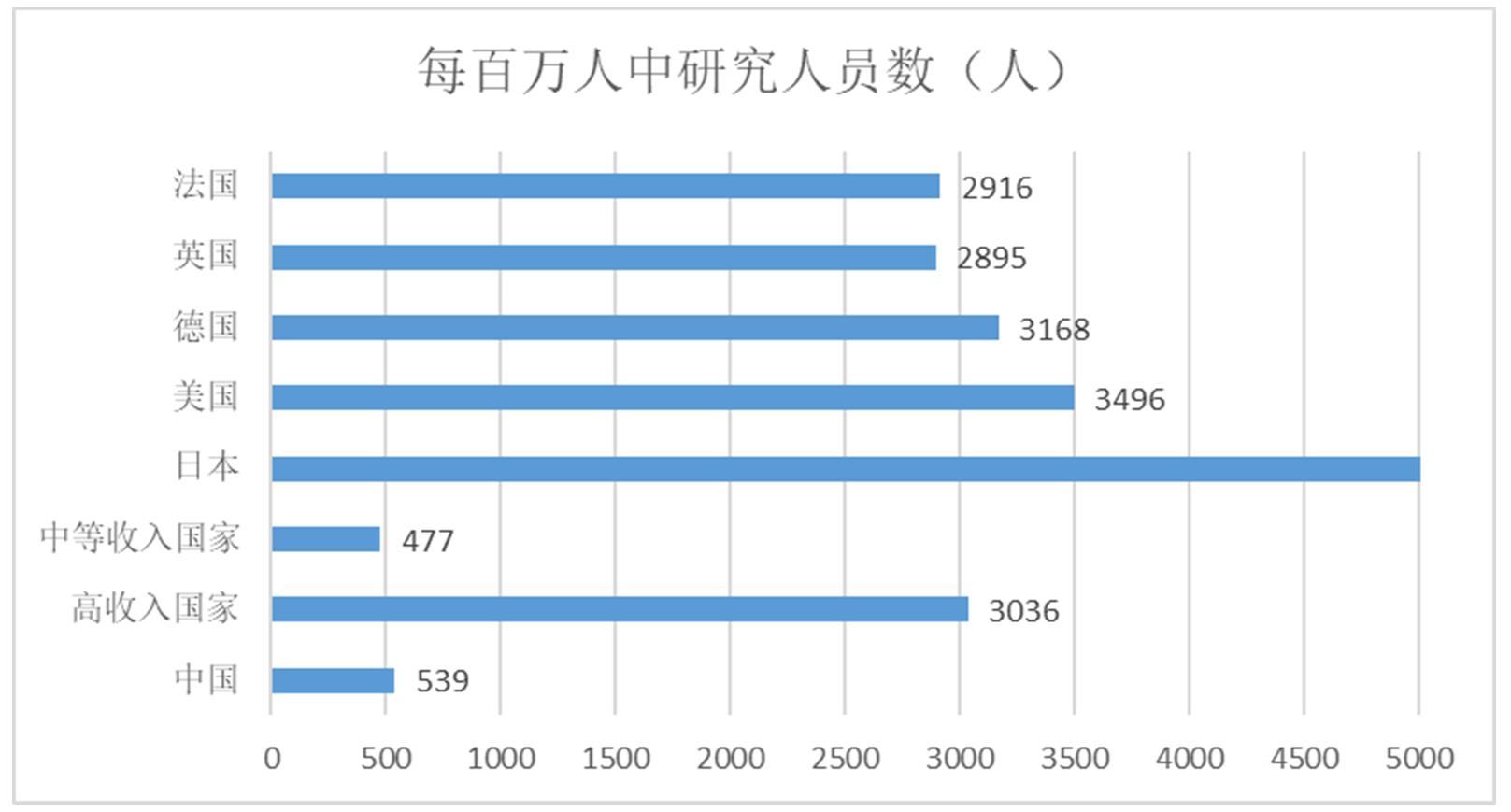
China Science and Technology Talents Development Report 2020 shows that the total number of scientific and technological talents in China has increased rapidly. In 2019, the total number of R&D personnel in the country was 7.13 million, 1.3 times that of 2015. However, there is still a big gap between China and developed countries in terms of scientific and technological talent reserve. In 2021, the number of researchers per million people in China was 539, which was lower than that in developed countries such as the United States (3,496), Japan (5,078), Germany (3,168) and France (1916), and the gap with the average level of high-income countries (3,036) was also very obvious (Figure 1).

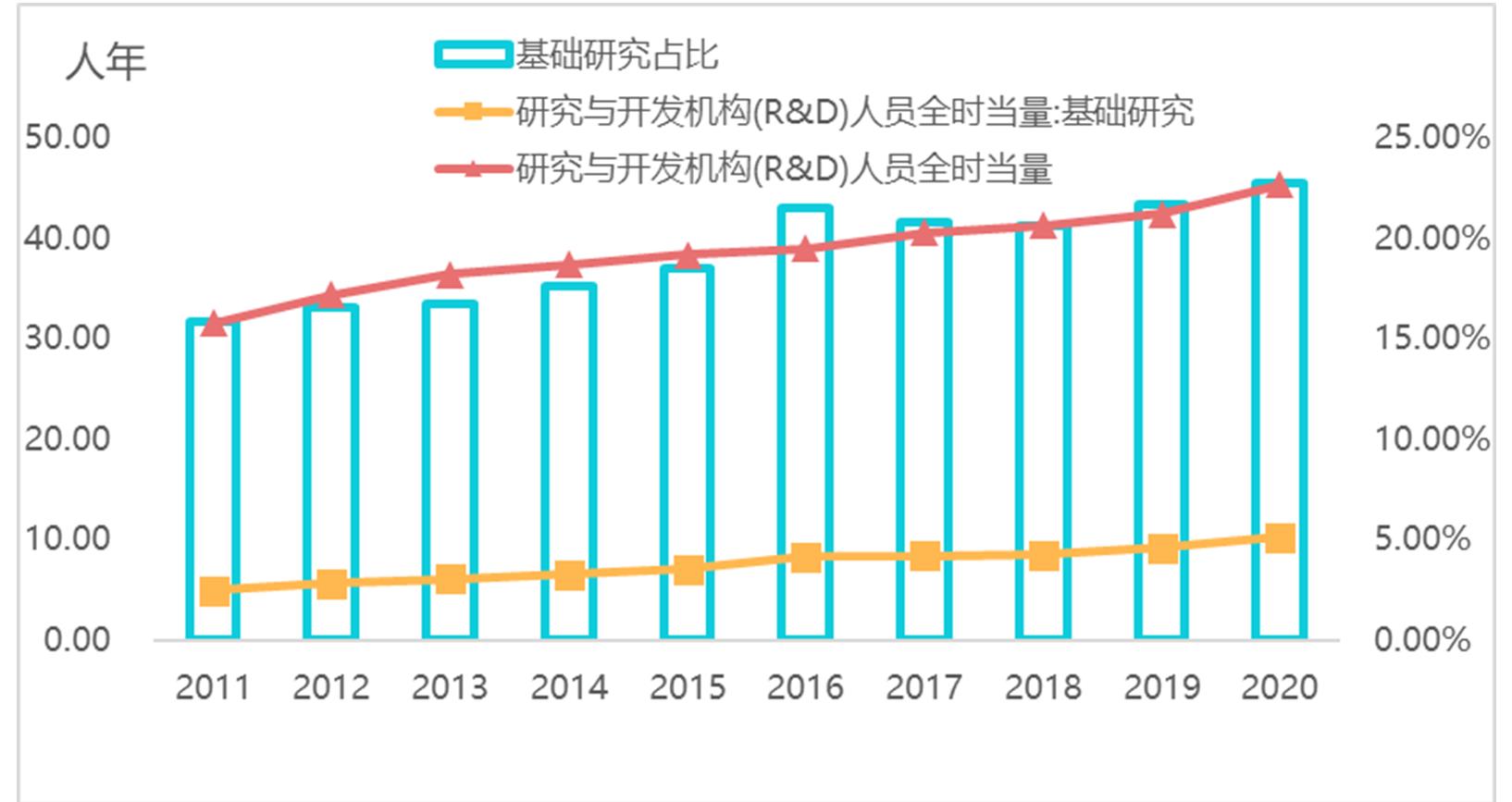
In 2021, the ranking of China Global Innovation Index has risen from 34th in 2012 to 12th. In recent ten years, the full-time equivalent of R&D personnel in China has also been continuously improved. However, the national R&D researchers account for only 43.9% of the full-time equivalent of R&D personnel, which is lower than that of major economies in the world (50%). Among them, the proportion of full-time equivalent of R&D basic researchers has a downward trend (Figure 2). There is still a big gap between China and the major countries in the world in the investment intensity of R&D personnel and the proportion of basic researchers in R&D personnel. In recent years, the growth rate of R&D personnel in enterprises has slowed down, which needs more attention.

Figure 1 Comparison of scientific and technological talents between China and developed countries in 2021 (person)

Data source: According to the data of International Statistical Yearbook 2021 of the National Bureau of Statistics.

Figure 2 Changes of full-time equivalent of R&D personnel in China from 2011 to 2020 (person-year,%)

Source: Wind database.

(B) The input-output efficiency of scientific research has improved significantly, but the value of human capital of scientific researchers has not been properly reflected.

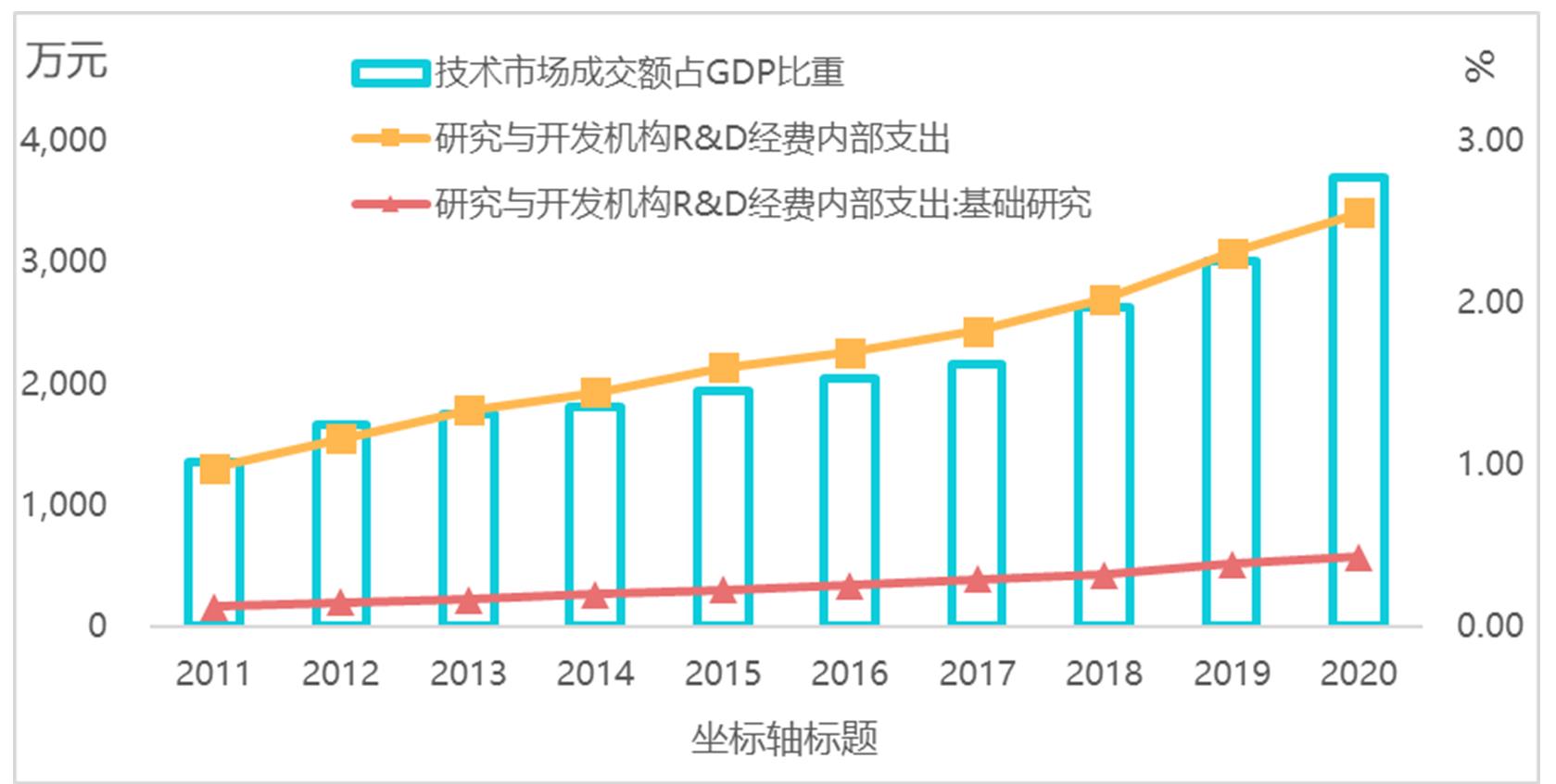
In recent years, the citation rate of China’s scientific research papers has increased significantly, and it has formed an influence in certain fields. According to the Statistical Report of Scientific Papers in China in 2021, the number of papers in top international journals in China ranks second in the world, rising by two places, and the number of highly cited papers and hot papers continues to rank second in the world, among which international co-authored papers account for 26.2% of the total published papers in China. However, China lacks originality and basic innovation, its core technology and bottom technology are still controlled by others, and its innovation ability still cannot meet the requirements of high-quality development, and there is still a gap with the world-class powers. At present, the transformation rate of scientific and technological achievements in China is only about 10%, and the industrialization rate is less than 5%. Take the proportion of internal expenditure of R&D funds and technology market transactions in GDP as an example, the proportion of basic research is low, and the growth rate is lower than that of internal expenditure of R&D funds. At the same time, the proportion of technology market transactions in GDP is less than 3% (Figure 3). The market-oriented conversion rate of scientific research results is not high, which affects the realization of human capital value of scientific researchers.

Figure 3 Changes of R&D investment in China from 2011 to 2020 (RMB 10,000,%)

Source: According to the Wind database.

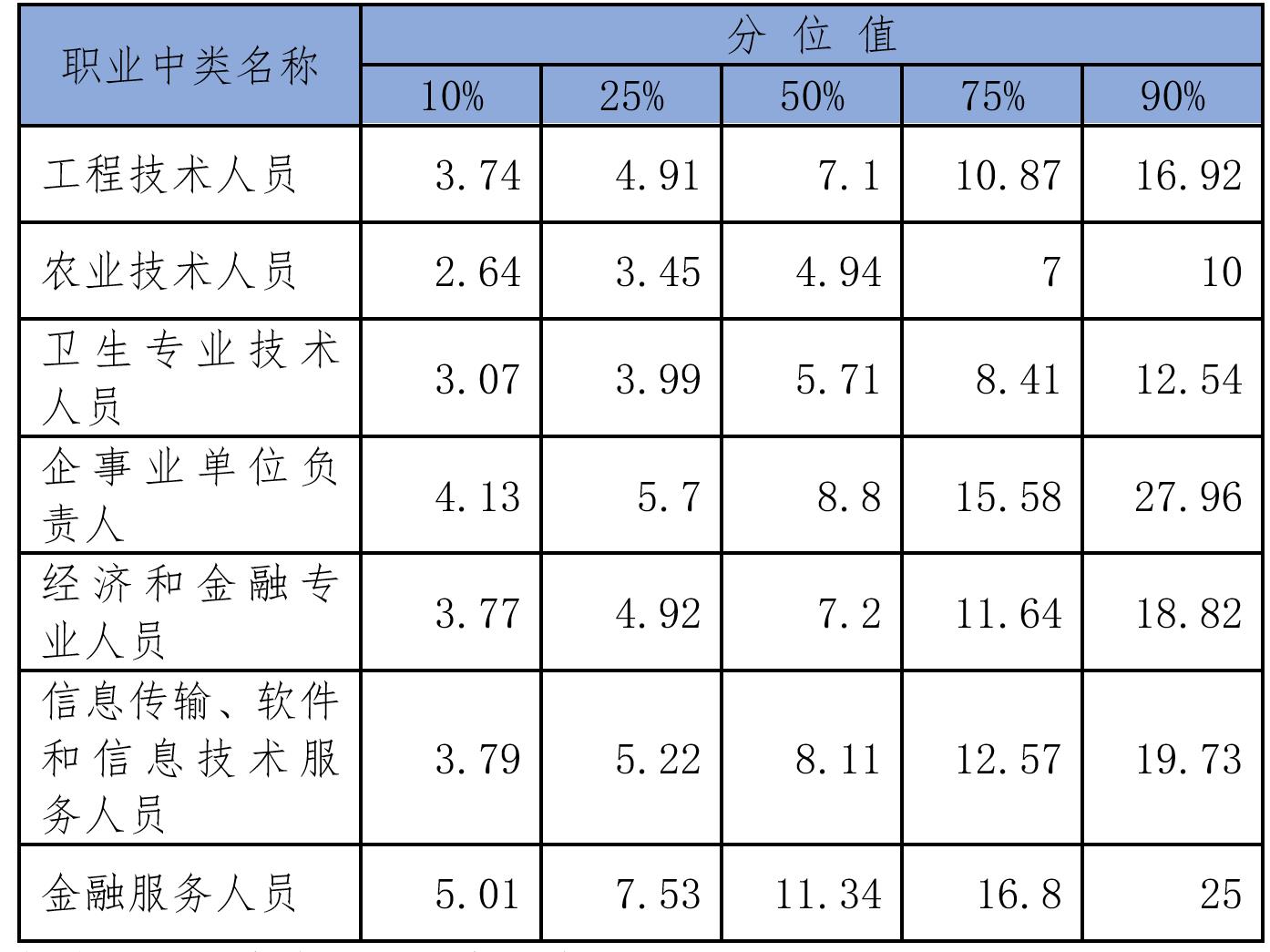
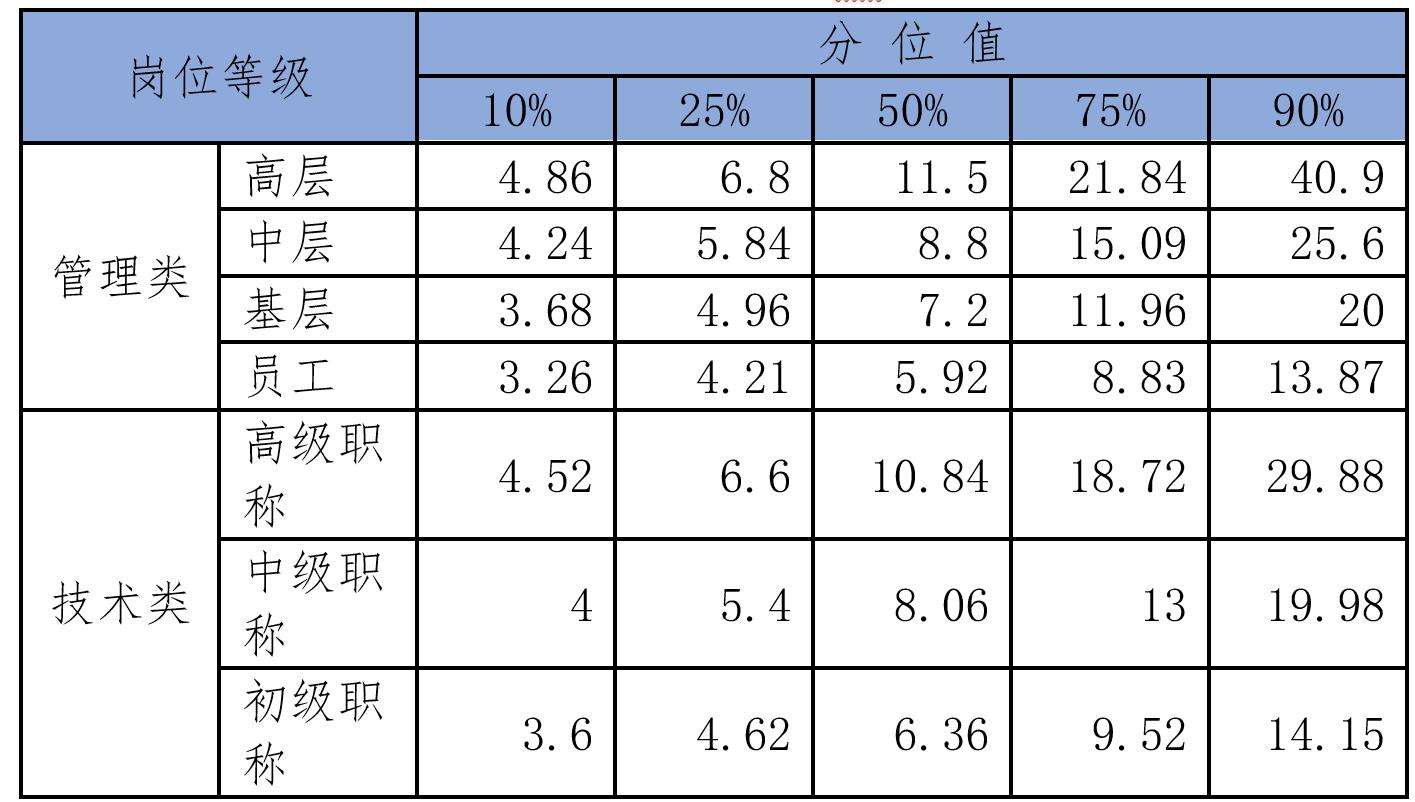
From the realization of human capital value of scientific researchers, in recent years, the salary of scientific and technological talents in China has increased steadily, but compared with other types of personnel at the same level, the salary level of scientific and technological personnel is still not competitive, and the salary level of scientific and technological personnel does not match its contribution. According to the salary survey data of enterprises in Ministry of Human Resources and Social Security, the median salary of engineering technicians, agricultural technicians and health professionals in China in 2021 was 71,000 yuan/year, 49,400 yuan/year and 57,100 yuan/year respectively, which was lower than the salary level of management, finance and IT (Table 1). From the comparison of job types in enterprises, taking the median salary as an example, the salary level of professional and technical personnel in the same rank is lower than that of management personnel (Table 2). In terms of industries, the wages of professional and technical personnel are generally above the average level of regulated enterprises, but in most industries, such as mining and manufacturing, the wages of professional and technical personnel are lower than those of managers of the same rank.

Table 1 Comparison of salaries of professional and technical personnel in China in 2021 (10,000 yuan/year)

Source: Ministry of Human Resources and Social Security.

Table 2 Comparison of salaries of technical and management personnel in China in 2021 (10,000 yuan/year)

Source: Ministry of Human Resources and Social Security.

(3) The level of scientific research opening has been greatly improved, but the phenomenon of brain drain is still outstanding.

In recent years, the level of scientific and technological talents’ foreign academic exchanges and scientific research cooperation in China has been continuously enhanced. According to Statistics of Scientific Papers in China in 2021 published by China Science and Technology Information Research, from 2011 to 2021, the proportion of papers produced by 10 disciplines in China exceeded 20% in the world. Among the international papers published in China in 2020, there were 144,500 international co-authored papers, up by 11.1% year-on-year. International co-authored papers account for 26.2% of the total published papers in China, and international co-authored papers with China as the first author account for 69.3% of all international co-authored papers in China, with partners involving 169 countries (regions).

However, for a long time, the loss of scientific and technological talents abroad, and the loss of scientific and technological talents from state-owned departments to the private sector is still relatively common. According to the data of the Ministry of Education, in 2022, nearly 700,000 China students chose to stay abroad, and the proportion of Tsinghua University and Peking University studying abroad reached 14.2% and 18.9%, while the proportion of Qingbei students returning to China was only 20%. According to a survey conducted by the Paulson Foundation in the United States in 2020, about 60% of AI scientists in the world work in American universities, companies or private research institutions, and two-thirds of them come to the United States for further study after graduating from other countries. The main source of students is China, accounting for 27%, and 32,000 Chinese scientists have voluntarily become American citizens. There are many high-end talents among them.

In addition, the state-owned sector is also facing the challenge of the flow of scientific and technological talents to private enterprises. According to the research and development center of China Academy of Launch Vehicle Technology on Aerospace Science and Technology Group, from 2012 to 2016, the total number of people leaving the main institutions of the group showed an upward trend, with the annual turnover rate exceeding 10%, and the loss was concentrated in the young and middle-aged backbone groups under 35.

Second, development concepts, institutional mechanisms and talent policies affect the release of talent vitality.

With the rapid changes of economic, social and technological progress, the traditional management mode of scientific and technological talents has not adapted to the development requirements of the new era, and the scientific research management system and mechanism restrict the development of scientific and technological talents’ innovation and creativity. At present, we need to stimulate the vitality of scientific and technological talents more than at any time in history, and it is urgent to press the "acceleration button" for talent reform.

(A) The concept of talent development, some regions and departments have failed to pay attention to the all-round development of people and the diversified demands of talents.

Some cadres have not fully applied the development law of scientific and technological talents, some ways of thinking are still in the era of planned economy, and some important decisions often "see things but not people", which is not enough to mobilize the enthusiasm of scientific and technological talents. In some jobs, there are many elements about the importance of talents, but there are not many practical and effective measures to stimulate the vitality of talents. Some state-owned units are still stuck in the traditional personnel management mode, and the talent management mode is extensive and backward, emphasizing material incentives and neglecting the shaping of talent environment. There are still many institutional and institutional obstacles in personnel training, introduction, use, motivation and mobility, and the system of introducing foreign talents and high-end skilled immigrants is still not perfect.

The concept of all-round development of scientific and technological talents has not yet been formed, the training of top-notch innovative talents is lagging behind, the education system has put too much emphasis on result orientation, and the atmosphere of attaching importance to exam-oriented education and knowledge infusion, ignoring interest cultivation and innovation discovery is still very strong. Some highly educated international students have global vision and cutting-edge knowledge, and have been integrated into the forefront of global scientific and technological development. However, the attraction of these talents returning to China for development is insufficient, and the brain drain problem is still outstanding. There is still a big gap between China and the global talent center.

The "administrative color" of scientific research personnel management is still very prominent, which emphasizes management over service. There are many reports, many approvals and long time-consuming in the declaration and evaluation of scientific research projects, and scientific research personnel have to spend a lot of time and energy in administrative affairs. There are too many detailed items in the budget of scientific research funds, and many requirements are not suitable for the uncertainty and periodicity of scientific research activities. There are many restrictions on the payment of wages and labor expenses for scientific research funds, and the knowledge labor of scientific research personnel cannot be properly reflected. Excessive frequent assessment restricts the initiative of scientific and technological talents to concentrate on research. According to a survey conducted by the Policy Research Group of the Talent Center of the Ministry of Science and Technology, the three measures that scientific and technological talents most want to speed up implementation are loosening burdens, supporting talents to carry out basic research for a long time and giving them greater autonomy, with the selection ratios of 40.2%, 35.9% and 32.8% respectively.

(B) Talent incentive mechanism, the decisive role of the market in the allocation of talent resources is not fully played.

The system and mechanism to promote the entrepreneurship of scientific and technological talent officers need to be further optimized, the decisive role of the market in the allocation of human resources has not been fully exerted, and the human capital value of scientific and technological talents has not been properly reflected. In recent years, the internationalization, marketization and competitiveness of scientific and technological personnel in China’s state-owned departments have been continuously improved. However, in some state-owned enterprises, the problems of "lying flat", "Buddhism" and overstaffed personnel are still outstanding. Due to strict identity management, low salary and narrow promotion space, some state-owned departments have lost their own scientific and technological talents, and the ranks of scientific and technological talents are unstable.

Due to the unreasonable performance appraisal and salary distribution system, some units can not reflect more work and more pay, and distribution according to work, which leads to many scientific and technological talents in state-owned enterprises doing more and doing less, and doing the same with not doing it. There are also some enterprises that lack an incentive job development system, which makes it difficult for scientific and technological talents to be promoted and moved. Some talents can’t see their career development prospects and their entrepreneurial enthusiasm can’t be mobilized. In some public-owned units, the talent incentive means is single, so it is difficult to mobilize the entrepreneurial enthusiasm of talent officers, and the reform of salary distribution such as equity incentive is slow. Especially under the background of digital economy, human capital elements play a prominent role in various enterprises, but the human capital value of core technicians and outstanding operators has not been properly reflected after the reform. The traditional salary system, which mainly focuses on wages and bonuses, can no longer meet the needs of enterprise development. The reform of state-owned enterprises in market-oriented selection, contractual management, differentiated salary and market-oriented exit is not in place, and they cannot retain core talents, so they are at a relative disadvantage in talent competition.

(C) In terms of talent policy, there are problems such as weak pertinence, difficult implementation and untimely evaluation.

In recent years, in order to mobilize the enthusiasm of scientific research talents, many talent policies have been issued from the central government to the local government, such as Guiding Opinions on Supporting and Encouraging the Innovation and Entrepreneurship of Professional and Technical Personnel in Institutions and Guiding Opinions on Implementing the Distribution Policy Oriented to Increasing Knowledge Value. However, there are still some problems in the process of policy implementation, such as weak pertinence, difficult implementation, lack of supporting facilities and untimely evaluation, which cause "good policies" to fail to achieve "good results". Take actively encouraging scientific researchers to take part-time jobs, take part in projects and start businesses as an example. Due to the lack of supporting implementation rules, some scientific research units are difficult to grasp who can take part-time jobs, how to manage part-time workers and how to confirm knowledge achievements, and there are practical difficulties such as "thinking out" and "going out can’t come back". The lack of evaluation of the talent policy that has been implemented for a period of time is not conducive to policy iteration, and it is not conducive to timely adjustment, which affects the effect of policy implementation. 

Third, countermeasures and suggestions

Talent vitality is "released", not "managed". It is suggested to further change the concept of talents, speed up the "streamline administration, delegate power, strengthen regulation and improve services" reform in the field of talents, optimize the talent policy, create a better talent ecology, and create conditions for further releasing the vitality of talents.

The first is to change the concept of talent development and promote the development of talent career with comprehensive evaluation of talents.In terms of talent concept, it is necessary to further improve the evaluation system of scientific and technological talents with classification, scientific diversity and openness. According to the job characteristics, set evaluation indicators, and recognize the performance of job responsibilities, participation in scientific research work, high-level papers published, and the effectiveness of achievements transformation as contributions, so as to avoid using only signed achievements as the basis for assessment and evaluation.

The second is to speed up the reform of the system of scientific and technological talents and stimulate the innovation vitality of scientific and technological talents with the guidance of increasing knowledge value.On the basis of ensuring the normal growth of the basic salary level, we will gradually increase the basic salary that reflects the innovative talents to perform their duties and responsibilities, and increase the autonomy of performance pay. We will increase the sharing ratio of scientific and technological achievements of researchers, and increase the fruitful income of researchers through multiple channels. Give researchers the long-term right to use their scientific and technological achievements for not less than 10 years, and clarify the specific operation methods for researchers to take part-time jobs.

The third is to speed up the reform of "streamline administration, delegate power, strengthen regulation and improve services" for scientific and technological talents and further create "relaxation" for scientific research.Give scientists more power to decide the technical route, control more funds and dispatch more resources, and accelerate the formation of strategic fulcrum and yan zhen pattern. Promote scientific research units to reduce the frequency of assessment, implement medium-and long-term assessment such as employment period assessment and project cycle assessment, and simplify and dilute the usual assessment. Open major national scientific research infrastructure and large-scale scientific research instruments to the society, and improve the use efficiency of scientific research equipment and the synergistic effect of innovation.

The fourth is to optimize all kinds of talent policies and actively shape the ecological environment of scientific and technological talents suitable for people to give full play to their talents.Vigorously carry forward the spirit of "two bombs and one satellite" with innovation as the core in the whole society, and vigorously cultivate an environment that encourages innovation and tolerates failure. Consultation channels should be established for management issues and financial systems with strong policies, and good practices, experiences and cases of local and unit scientific and technological talents development should be well publicized. 

(The author Qian Cheng is an associate researcher at the Institute of Public Administration and Human Resources of the State Council Development Research Center; Feng Wenmeng is a researcher at the Institute of Public Administration and Human Resources of the State Council Development Research Center)

Changsha man’s heart stopped while playing football, and his teammates beat death in 7 minutes and 25 seconds.

Huasheng Online September 13 th (all-media reporter Tian Tian trainee reporter,
Zeng Guanlin) A man in Changsha suddenly fell to the ground while playing football, and his heart stopped. Three seconds after falling to the ground, the referee immediately suspended the game; 1 minute and 23 seconds, Yuan Biao, deputy director of the emergency department and deputy chief physician of Changsha Central Hospital, participated in the competition and performed cardiopulmonary resuscitation on the spot; At 3 minutes and 02 seconds, the teammate took the AED first aid equipment from the customer service center; In July 25 seconds, the players who fell to the ground regained consciousness, breathing and heartbeat, and the rescue was successful. He was only one step away from death, but now everything is normal.

On September 8, a relay rescue about life was staged in Changsha. A group of Changsha men successfully beat the god of death in 7 minutes and 25 seconds. Behind the thrilling is the double guarantee of first aid knowledge and first aid equipment.

Today, Yuan Biao received pennants and flowers from the families of the rescued players.

Thrilling for 7 minutes, textbook rescue creates miracles.

"Thank you! Without you, our family would be ruined. " This morning, Yuan Biao, who was busy in Changsha Central Hospital, was held tightly by the families of the rescued team members. Having been a doctor for many years, it is his duty to save lives. Unexpectedly, outside the ward, excellent first aid skills also helped him successfully save a fresh life.

On September 8, it was the match day of Yuan Biao’s OAK football team. Although it is only an amateur team composed of owners in Yuelu District and Yanghu District, everyone pays special attention to the game, and specially invited professional referees and photographers, and every player is ready.

At 20: 30 that night, about 60 minutes after the start of the game, in the midfield where the ball was being passed fiercely, suddenly a player slipped to the ground holding his knee. The sound of hitting the ground quickly caught the attention of teammates around.

In the third second after the players fell to the ground, the referee blew the whistle urgently and suspended the game.

In 12 seconds, the captain called for help, and more teammates heard the sound, including Yuan Biao. "At that time, I went forward to check the situation, and I couldn’t feel my breathing and pulse." Captain Wang’s first reaction was that his teammate might have a cardiac arrest. He immediately opened his mouth, tried his best to keep the respiratory tract unobstructed, and asked other teammates to call 120.

In 20 seconds, the teammate dialed 120 emergency calls. After the call was dialed, 120 emergency personnel kept talking to guide the on-site rescue.

In 30 seconds, the teammates dispersed, and many people took off their clothes to serve as fans for those who fell to the ground.

In 56 seconds, the team members quickly went to the customer service center of Yanghu Sports Park to get AED first aid equipment. "This instrument is an indispensable artifact in the first aid of cardiac arrest." Yuan Biao introduced that once cardiac arrest occurs, 4 minutes is the golden rescue time, and then the survival rate decreases by 10% every minute. After more than 10 minutes, the survival rate is almost zero. "Every minute and every second of us is racing against death."

At 1 minute and 23 seconds, Yuan Biao started cardiopulmonary resuscitation.

At 3 minutes and 02 seconds, the AED was in place, and the hope of life increased by one point. Because cardiopulmonary resuscitation requires a lot of physical strength, Yuan Biao, who has been exercising for a long time and has been rescuing, is obviously exhausted and sweaty. Seeing that his physical strength was in a hurry, his teammates began to shout around the stadium, "Is there anyone who can give first aid, please help to save people …" Ren Ruolan, a doctor of rehabilitation medicine and physiotherapy of Hunan Armed Police Corps Hospital, was doing frisbee exercise nearby.

3 minutes and 52 seconds, Ren Ruolan took part in the first aid relay.

On June 28th, an electric shock was given to a teammate who fell to the ground with AED emergency equipment.

At 7 minutes and 17 seconds, a miracle appeared. The teammates who had never had independent consciousness before recovered their weak consciousness.

In July 25 seconds, the teammates who fell to the ground regained consciousness, breathing and heartbeat, and the rescue was successful.

At 15 minutes and 05 seconds, the ambulance arrived and watched the teammates who fell to the ground be carried into the ambulance. Someone at the place breathed a sigh of relief. Whether familiar or strangers, excitedly high-five, everyone knows that they have won this fight with death.

Behind the miracle is the double guarantee of first aid knowledge and equipment.

"I never think miracles can happen at any time. We should learn from them." Yuan Biao said that in recent years, with the popularization of first aid knowledge, more and more people began to know the importance of first aid knowledge, but they still lacked experience and needed more simulation practice.

"There is also the need to equip public places with AEDs." According to Yuan Biao, as early as 2019, the Basic Medical Care and Health Promotion Law of People’s Republic of China (PRC) made it clear that public places should be equipped with necessary first-aid equipment and facilities such as automatic external defibrillator (AED) according to regulations to improve the efficiency of pre-hospital first aid. At present, many public places in Changsha are equipped with first aid equipment, but many citizens don’t know about it, let alone use it.

What needs to be paid attention to is that many people think that sudden death generally occurs in the elderly, but in recent years, sudden death has occurred in young and middle-aged people, especially those aged 35 to 50. There are many reasons for sudden death, which are not very clear, but the inducing factors such as hypertension, diabetes and other basic diseases, smoking, alcoholism, obesity, irregular life, stress and staying up late may also lead to sudden death. It is recommended to have regular physical examinations and pay attention to physical health.

Yuan Biao reminded that when doing strenuous exercise, you must do what you can. When you feel that your physical strength is in a hurry, you must stop and rest, and don’t overload your exercise.

Link:

What you need to know about sudden death from sports.

Sports sudden death refers to non-traumatic accidental death that occurs during exercise or within 24 hours after exercise. Exercise is not the main cause of sudden death, but the hidden heart disease is the "behind-the-scenes" of sudden death caused by exercise. Sudden death can be divided into cardiogenic and non-cardiogenic. Cardiogenic refers to the onset of cardiovascular diseases, of which coronary heart disease is the most common. Non-cardiogenic factors include overwork, alcoholism, taking drugs, strenuous exercise and so on.

Stay away from danger during exercise, and pay attention to the following points:

1. Check risks before exercise: Conduct regular physical examination, especially cardiovascular system examination, to check potential disease threats.

2. Ensure adequate warm-up: Warm-up before exercise can make as much blood flow to the heart, lungs and muscles as possible, improve the metabolic capacity of the heart and lungs, and ensure that the energy metabolism of the human body can meet the needs of exercise after entering high-intensity exercise.

3, exercise should not be overloaded: when exercising, do what you can, feel physical emergency or physical discomfort, be sure to stop and rest, do not overload exercise.

4. Replenish energy in time: sports drinks, energy bars and salt pills should be replenished in time for long-term or intense exercise.

5, sick and unwell, do not exercise: cold and fever make the body’s immune ability decline, and it is not recommended to exercise vigorously when you are very tired and stay up late.

6. Don’t stop immediately after exercise: Don’t stop immediately after exercise and give your body a buffer time. You can do some static stretching actions together, and don’t take a shower immediately, drink a lot of ice drinks, blow air or blow air conditioning.

What is an AED?

AED is the abbreviation of external automatic defibrillator. It is a medical device with a computer, which can evaluate the patient’s heart rhythm and transmit electric shock to the heart when the rhythm time of electric shock is detected.

Ventricular fibrillation is a disorderly activity of the patient’s cardiac electrophysiological system (this state can occur in atrium or ventricle). When it occurs in the ventricle, it will vibrate in a rapid and disorderly way, preventing the ventricle from pumping blood to the whole body. AED can remove ventricular fibrillation by electric shock and make the heart return to normal work. Patients with cardiac arrest have the greatest chance of survival if they perform cardiopulmonary resuscitation immediately and use AED within a few minutes.

(First trial: Huang Juan, second trial: Peng Zhiguo, third trial: Zhou Wenbo)

Holidays will end and work can be done to prevent holiday syndrome.

  BEIJING, Beijing, Oct. 7 (Wu Tao)-"Braised pork every day, red daughters every day" This is the life that many people have spent during the National Day holiday. In addition, they have been running around and playing mobile phones all night. From the experience, many people will have holiday syndrome after the holiday? Don’t worry, here’s a little suggestion to get your state back quickly.

  Change the diet structure reasonably and eat more vegetables.

  Holiday syndrome is a variety of physiological or psychological manifestations that people appear after the holiday, such as feeling bored, listless, inefficient at work and study, and even unexplained nausea and neurasthenia in the days after the holiday.

  Prevention must be broken from all aspects, the first is to change the diet structure reasonably. Ma Guansheng, a professor at peking university health science center School of Public Health, suggested that the post-holiday diet can appropriately reduce meat intake and eat more cereals and green vegetables, "especially dark-colored vegetables rich in B vitamins and minerals."

  However, Ma Guansheng also stressed that "the post-holiday diet adjustment should follow the principle of diversity, and the nutrition of a single food is definitely not comprehensive. &lsquo; Eating only vegetarian food is good for health &rsquo; It is also unscientific, because if you eat too lightly, it will also lead to insufficient intake of micronutrients and high-quality protein. "

  In addition, white-collar Tiaotiao (pseudonym), who has experience in preventing holiday syndrome, told Zhongxin. com that moderate exercise after the holiday can regain vitality, such as doing some aerobic exercise, running, playing ball games, etc., so that his heart beats faster and he sweats, which can make his state come back quickly, especially with a good appetite.

  Adjust the schedule, go to bed early and get up early.

  It is normal for many people to stay up late on holidays. Coupled with the rush of the road, the biological clock is completely disrupted. Therefore, it is necessary to adjust the work and rest in time after the holiday. It is best to lie in bed 2 hours in advance at night, not to play mobile phones in bed, set the alarm clock, go to bed early and get up early.

  What, can’t sleep? A hot bath and a cup of hot milk before going to bed are excellent. In addition, soaking your feet in hot water and listening to music before going to bed also help you sleep.

  If you don’t feel refreshed at work, you can have some coffee or tea to refresh yourself. If possible, you can have a rest at noon and be more energetic in the afternoon.

  Work plan, step by step.

  Eat, sleep well, roll up your sleeves and start working. But the reality is that some office workers will have anxiety, depression, irritability and other emotions after the holiday, and even have a fear of going to work. They are also grasping their beards and eyebrows at work, which is completely inefficient.

  Zhao Yuechen, director of china association of social workers Social Mental Health Service Guidance Center, suggested that it is best to arrange the work quantitatively, define the daily tasks, keep the normal pace of life and work, and put aside the boredom of work.

  However, it is not advisable to carry out intensive study and work in a short time after the festival, but to finish the most important and urgent things step by step.

  "If there are slacking people around you, try not to be together and avoid each other &lsquo; Infection &rsquo; 。” Zhao Yuechen also suggested.

70 years of great changes | 700,000 "Ecological Guard" to protect the green waters and green mountains of Tibet

  Xinhua News Agency, Lhasa, July 13  Title: 700,000 "Ecological Guard" to protect the green waters and green mountains of Tibet

  Xinhua News Agency reporter Tian Jinwen

  The reporter learned from the Tibet Autonomous Region government that in recent years, Tibet has combined the protection and construction of ecological security barriers to increase the transfer payment of key national ecological function areas, so that the masses can fully enjoy the ecological policy dividends. According to statistics, since 2016, Tibet has provided 700,000 ecological jobs for the masses, and the masses have increased their income by nearly 4 billion yuan.

  Herdsmen lead sheep through Selinco (drone photo on April 29, 2020). Xinhua News Agency reporter Tian Jinwen

  On a mid-summer morning, in the Selinco National Nature Reserve, the wild guard Tsicheng Taqing left the house early in the morning. "This season is the season for the Tibetan antelope to give birth. I patrol around the reserve every morning to observe the wild animals and see if they need help." Tsicheng Taqing said. "The job of the wild guard is very good. It can not only contribute to the protection of the ecological environment of the hometown, but also earn a salary."

  In Shenzha County, Nagqu City, Tibet Autonomous Region, there are 42 wild guards like Cicheng Taqing, each of whom earns 3,000 yuan per month. Thanks to their efforts, the ecological environment of Selincuo National Nature Reserve is currently well maintained.

Tacheng Taqing (third from left in the first row) and fellow forest rangers (photo taken on February 14, 2021). Xinhua News Agency reporter Tian Jinwen

  This is due to the fact that Tibet relies on special project funds such as national grassland ecological protection subsidies and awards, forest ecological benefit compensation, etc., to implement the policy of assigning posts and assigning staff, assigning responsibilities and paying salaries to the poor who have the ability to work.

  In Zhaxue Township, Mozhugongka County, Lhasa City, Pu Tsering has been guarding the mountain forest for several years.

  Pu Tsering said that more than a decade ago, local people needed firewood for heating and cooking in winter, and nearby villagers used to go up the mountain to cut down trees. Not only that, but in Mozhugongka County, there are also wild animals such as black-necked cranes and red deer that migrate and live here being poached.

  Due to the large area of the reserve, Pu Tsering spent a lot of time on each patrol. When he met someone who was cutting down trees, he would patiently persuade them, and he would also carry out publicity and education on ecological protection in nearby villages. If he did not listen to the persuasion of education, he would take them back to the control station and wait for the relevant departments to come and deal with them.

  Farmers and herdsmen no longer compete with nature for food, but eat ecological protection food. By participating in public welfare forest management and protection to obtain labor income, the living conditions of some ordinary people have been substantially changed. In Zhaxue Township, where bicycles were formerly only seen, now every household has a motorcycle, and some people even drive a car.

  Nowadays, more and more farmers and herdsmen have become rangers, forest rangers, and wetland conservationists, becoming "ecological guardians" of the snowy plateau, and also achieving increased income in protecting the environment.

Ningbo area eπ 008 is being discounted, the latest offer 188,600! Great offer today

[Autohome Ningbo Discount Promotion Channel] Recently, the much-watched models have ushered in a large discount in the Ningbo market, with a maximum discount of 28,000 yuan and a minimum starting price of only 188,600 yuan. This promotion is in full swing. If you are interested in this model, you may wish to click "Check Car Price" in the quotation form to get higher discounts.

宁波地区eπ008正在优惠,最新报价18.86万!今日钜惠

eπ008采用流线型的设计语言,展现出强烈的未来感。前脸采用封闭式进气格栅设计,巧妙地融合了科技感与现代感。两侧大灯组造型独特,线条犀利,展现出强烈的视觉冲击力。整体风格简洁大气,彰显出eπ008的高端定位。

eπ008的车身尺寸为长5002mm、宽1972mm、高1732mm,轴距为3025mm。前轮距和后轮距均为1650mm,为车内空间提供了良好的支撑。车身侧面线条流畅,搭配265/45 R21规格的轮胎,轮圈设计时尚大气,凸显了车辆的运动风格。

宁波地区eπ008正在优惠,最新报价18.86万!今日钜惠

eπ008的内饰设计采用简约而不失科技感的风格,为驾乘者带来舒适的驾驶体验。中控台配备了一块15.6英寸的高清触控屏幕,集成了多媒体系统、导航、电话及空调控制等功能,用户可以通过语音识别控制系统轻松操作,提升了驾驶便捷性。方向盘采用皮质包裹,手感舒适,并支持手动上下和前后调节,满足不同驾驶者的个性化需求。此外,车内提供多个USB和Type-C接口,方便乘客连接设备充电,并设有前排无线充电功能。座椅采用仿皮材质,主副驾驶座椅不仅支持多向调节,还具备加热、通风功能,其中驾驶位座椅还特别配备了头枕扬声器,为驾驶者带来独特的听觉享受。前后排座椅均支持电动记忆功能,方便用户快速调整到最舒适的位置。第二排座椅则具备多向调节功能,包括前后移动、靠背倾斜和腿托调节,提供灵活的乘坐空间,确保乘客在长途旅行中的舒适度。

宁波地区eπ008正在优惠,最新报价18.86万!今日钜惠

eπ008配备了强劲的电动机,最大功率达到200千瓦,峰值扭矩为340牛·米,为车辆提供了卓越的动力表现和加速性能。

汽车之家车主对eπ008的外观评价非常积极,他表示外观个人觉得很大气,是我喜欢的感觉。他认为外观主要看个人喜好,但还是觉得非常赞,并建议选择白色,大气还不用加钱。

Pull the goods for the plane with an unmanned vehicle! The performance soared 10 times. Wu Gansha’s Yushi Technology this year.

Pull the goods for the plane with an unmanned vehicle! The performance soared 10 times. Wu Gansha's Yushi Technology this year.

In the field of domestic autonomous driving, Yushi Technology, co-founded by Wu Gansha, former president of Intel China Research Institute, has to be mentioned.

However, due to shifting the focus of their work, Yushi Technology and Wu Gansha themselves have greatly reduced the frequency of speaking out since the middle of last year, which means "retiring from the rivers and lakes" and is slightly mysterious.

A few days ago, with the launch of GTIC 2018 Global Smart Car Supply Chain Innovation Summit, Chedong went to the Beijing office of Yushi Technology to have another in-depth dialogue with Wu Gansha, the guest of this summit, and learned about the breakthroughs made by Yushi Technology in technology research and development and commercialization during the dormant year:

Including the deployment of unmanned electric logistics trailers at the top three international airports in the world, the deployment of unmanned feeder vehicles in Zhejiang and Nanjing, the joint research and development of automatic parking service technology with domestic top automakers and time-sharing leasing enterprises, and the cooperation with passenger car enterprises to develop L2.5/L3 autonomous driving technology.

Wu Gansha even told the car that it has achieved a 10-fold increase in the number of customers, the number of contracts, the contract amount and the number of vehicles equipped with the automatic driving system, and the results are gratifying.

"Retirement" Achievement: Finalizing Master Plan

"The first year of entrepreneurship is blowing outside, the second year is blowing inside, and the third year is blowing again." As for the reasons for keeping a low profile in recent years, Wu Gansha explained this.

In his view, the first year of starting a business is nothing more than looking for someone to find money, the second year is to find business cooperation with customers, and the focus of the third year is on the one hand to cash the blown cows, and on the other hand, the rapid growth of the company needs "calcium supplementation", especially in refined management and cultural construction.

Wu Gansha told Che that during the "silence" of Yushi Technology, the team completed a very important thing, that is, finalized the Master Plan—— of Yushi Technology-the company’s overall development plan for the next five to ten years. It is understood that the plan is divided into three parts:

First of all, in the field of commercial vehicles and special vehicles, we should try to find a direction that is suitable for autonomous driving technology and can bring high profits at the same time, so as to accumulate research and development data and build corporate image while earning income.

Secondly, after the technology has been developed to a certain extent, we will start to cooperate with passenger car manufacturers to mass-produce and deploy parking service and L2/L3 autonomous driving technologies.

With the gradual increase of deployed vehicles, Yushi will be able to accumulate more data to improve the mass-produced autonomous driving technology, and at the same time, it will start the "shadow mode", that is, collect the road condition data of mass-produced vehicles through the sensors of existing vehicles, and train the decision-making algorithm of L4/L5 autonomous driving technology on the on-board computing platform.

Finally, Yushi Technology hopes to deploy an autopilot system with "shadow mode" on 10 million production vehicles in the future, so as to ensure that each iteration of L4/5 autopilot algorithm can complete tens of billions of kilometers of real vehicle verification within one month. Finally, mass production of L4/5 autonomous driving technology will be realized around 2025.

In addition to making a grand, even slightly exaggerated Master Plan, Yushi Technology is also recruiting a lot of people to ensure the realization of the above plan.

Wu Gansha told Che Dongxi that Yushi Technology currently has three R&D bases in Fangshan, Haidian, Beijing and Jiading, Shanghai, and its research engineering team is close to hundreds of people.

Pull the goods for the plane with an unmanned vehicle! The performance soared 10 times. Wu Gansha's Yushi Technology this year.

▲ Some members of the dominant team

In addition, Yushi Technology also has a trial production, testing and application innovation center in Jiaxing, Zhejiang Province, which is engaged in batch modification of self-driving vehicles, production and testing of low-speed vehicles, and has offices in Liuzhou and Shenzhen to carry out trial operation and joint research and development with partners.

Business progress: achieve four tenfold growth in one year.

Master Plan of Yushi is ambitious, but it is a plan after all. Cars are actually more concerned about what practical achievements Yushi Technology has made in the past year.

"10 times." Wu Gansha said with a smile, "and it is still four times 10 times."

He told Chedong that during the year from August 2017 to August 2018, Yushi Technology has achieved a 10-fold increase in four key indicators: the number of customers, the number of contracts, the contract amount and the number of vehicles equipped with Yushi automatic driving system. At present, it has more than 20 customers, of which about 80% are car companies, covering independent, joint venture and foreign-funded brand manufacturers, as well as passenger cars and commercial vehicles.

"This year, it is obvious that there are more customers of joint venture and foreign car companies," Wu Gansha explained. "The self-driving technology developed abroad may not be able to adapt to the complicated domestic road conditions, and the internationally accepted data governance regulations do not allow data to be sent abroad, so joint venture and foreign car companies also need local research and development and local partners."

Wu Gansha also showed the car a video of a specific project at the scene.

One of them is in the top three international airports in the world, and Yushi Technology has deployed several self-developed unmanned electric logistics trailers. These vehicles are parked next to the plane, and after the luggage and other goods on the plane are unloaded, this unmanned vehicle drags the goods to the unloading area.

The video shows that this special vehicle can still run normally in heavy rain, and its automatic driving system can stop immediately to avoid collision when it recognizes the mineral water bottle and silk scarf that the tester suddenly throws into the middle of the road.

Wu Gansha told the car that because there is no cover and air conditioning, the drivers of airport special vehicles work in harsh conditions such as high and low temperature and loud noise from taking off and landing all the year round. Therefore, although the subsidy is high, they still can’t keep people, which has become a headache for airport operators.

Unmanned vehicles do not have these problems, so they received a positive response from the airport. After rigorous technical tests, the two sides quickly reached a commercial cooperation.

Most importantly, the project is not used for demonstration purposes. The data and operational experience accumulated by Yushi can not only continuously improve its driverless technology, but also deploy more unmanned vehicles at the airport to achieve benign development. Wu Gansha predicts that the project will start unmanned operation without on-board safety personnel within half a year. And this is the first step of Master Plan of Yushi Technology.

Technical progress: automatic parking service and L2.5 go first.

In the field of passenger cars, Yushi is currently promoting commercial landing mainly around AVP and L2+ autonomous driving technology.

In addition to the above-mentioned airport video, Wu Gansha also showed Che Dongxi his technology Demo of developing AVP(Automated Valet Parking) automatic parking service for an independent passenger car brand.

In the video, a passenger car equipped with AVP technology drives to the door of an underground garage, and then the human driver gets off, and the vehicle drives into the basement to find the designated parking space and back into place. When the driver needs to drive, operate on the mobile APP, and the vehicle will drive on the road from the garage by itself.

It is understood that the AVP system of Yushi can be realized only by low-cost sensors such as cameras and ultrasonic radars, and its products have two modes:

1. For the parking spaces in fixed parking lots, vehicles can remember the corresponding routes by learning the driving of human drivers, so that the automatic parking service can be completed without relying on high-precision maps.

2. For parking spaces in unfamiliar parking lots, vehicles can find designated parking spaces or random empty parking spaces by themselves with the support of limited high-precision maps, and complete parking.

Wu Gansha told the car that this AVP system is being jointly developed with the OEM, and it is expected to cooperate with the OEM or the head time-sharing company to achieve scale deployment before the end of this year.

In addition to AVP system, another major layout of Yushi in the field of passenger cars revolves around L2+ autopilot technology, which is called L2.5 and L2.8 autopilot technology within Yushi.

Its L2.5-level technology can be simply understood as an upgraded version of Tesla Autopilot system. On structured roads such as expressways, vehicles can not only control their own speed and keep driving in a single lane, but also realize safe and automatic lane change.

The main body of L2.8 technology is the same as L2.5 technology, and the core is to increase the function of up and down ramps. According to Wu Gansha, the L2.8 technology of Yushi Technology should realize the automatic driving function of toll station-toll station, that is, consumers can give it to vehicles to drive when they drive to the toll station, and then they will be driven by humans after arriving at the destination toll station.

Of course, because this technical positioning is still below L3 level, human drivers still need to monitor the road conditions and be ready to take over at all times during driving, which is similar to the general Super Cruise positioning.

Wu Gansha revealed that this set of L2+ autopilot technology has basically matured, and is currently communicating with the OEM. It is expected that the SOP will be mass-produced as soon as 2020–this is the second step of the Master Plan.

Shadow mode: speeding up unmanned research and development

In the Master Plan, the shadow mode mentioned above plays a very important role, which is an important step to complete the research and development, data accumulation and verification of L4 autonomous driving technology.

After the above video demonstrating AVP automatic parking service technology, Wu Gansha also showed the progress of L4-class automatic driving technology.

In the video, the above-mentioned automatic parking service vehicle switches to L4 automatic driving mode after driving out of the parking lot, and automatically drives to the exit of the park. After the identification crossbar is lifted, it drives into the open road for testing.

In this process, the car has experienced many scenes such as crossroads/traffic lights, roundabout, tunnels, cities and highways, and it has successfully completed the driving task even in the face of complicated road conditions such as motor vehicles and non-motor vehicles, pedestrians and courier brothers.

According to Wu Gansha, this open road is an intelligent networked vehicle open test section that cooperates with the high-end manufacturing base in Fangshan District. It has long been a routine operation to conduct driverless testing on this section, and it has also experienced the test of bad weather such as heavy rain and severe winter. At present, Yushi is actively cooperating with OEMs to apply for road test licenses in Beijing, Shanghai and Jiashan, Zhejiang.

Open the trunk and there is only a clean "small box" in the car. This is the car brain independently developed by Yushi, which is equipped with two sets of algorithms, one is the above-mentioned automatic parking service system, and the other is the L4-level automatic driving which is still in iteration.

When the vehicle equipped with the car brain is driven by human beings, the algorithm of L4-level automatic driving technology verifies the algorithm by sharing data with the sensor under the condition of ensuring privacy, thus realizing the shadow mode.

Wu Gansha revealed that the car brain is fully developed in accordance with the car regulations, supporting a variety of chip mix and match schemes such as GPU, ASIC or FPGA. At present, the OEM is progressing smoothly.

Future play: positioning Tier 0.5

The entrepreneurial wave of autonomous driving technology has been rising for several years. Emerging companies and technology companies have two main directions in business models. First, unmanned taxis or unmanned car routes represented by industry leader Google Waymo also include startups such as Uber, Didi, Roadstar.ai

Another group of companies hope to provide auto-driving solutions with integrated software and hardware for mass production and loading, similar to what Tier1 does in the automobile industry.

Pull the goods for the plane with an unmanned vehicle! The performance soared 10 times. Wu Gansha's Yushi Technology this year.

▲ Yushi employees debug vehicles.

In the view of the first type of companies, technology companies have the problems of lack of experience and high threshold when they cut into the automobile industry. Therefore, it is better to cooperate with companies in the automobile industry to make unmanned vehicles and directly engage in the operation of unmanned car rental. The second kind of companies think that software technology is the weakness of the automobile industry companies and they have the ability to become the new Tier1.

Wu Gansha positioned Yu Shi’s choice of science and technology in the latter.

"Rand data shows that autonomous driving technology needs to run to 11 billion miles to prove statistically that it is safer than human drivers. If you want to run so many journeys, you need more vehicles equipped with shadow mode to run data." Regarding the reason for choosing the second route, Wu Gansha explained this.

At the same time, he also believes that the automatic driving system needs to be iteratively upgraded, which is different from the traditional one-off automobile parts. Therefore, Yushi defines its relationship with automobile enterprises as Tier0.5, that is, from the beginning, it will carry out joint research and development and joint data operation with automobile enterprises, instead of providing independent research and development parts systems to automobile enterprises like the traditional Tier1 and then matching them with the vehicles of the automobile factory.

At present, Yushi Technology has carried out joint research and development with many domestic automobile manufacturers, and its micro-circulation unmanned minibus and bus jointly developed with a head bus manufacturer will also be unveiled soon.

Conclusion: Autopilot veteran speeds up again.

Founded in early 2016 and headed by Wu Gansha, former president of Intel China Research Institute, Yushi Technology is regarded as one of the earliest self-driving startups in China. After intensive exposure at the beginning of its establishment, Yushi Technology began to fall into silence in the second half of 2017, even giving people the illusion that the company has fallen behind.
However, after two hours of in-depth communication with Wu Gansha, Che Dongxi clearly realized that Yushi Technology, a veteran autopilot, had not fallen behind, but had more achievements, which were illustrated by winning dozens of customers, deploying special unmanned vehicles at the top three international airports in the world, and developing L2+ autopilot technology and automatic parking service system for mass production.

With the determination of Master Plan for the next five years by Yushi Technology, the forward speed of this veteran will be further accelerated.